


Poly-Bernoulli number
 | This article has multiple issues. Please help improve it or discuss these issues on the talk page. (Learn how and when to remove these messages)
|


In mathematics, poly-Bernoulli numbers, denoted as is an integer sequence. [1]

Definition
[edit]It was defined by Kaneko as:
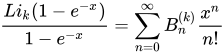
where Li is the polylogarithm. The are the usual Bernoulli numbers.

Moreover, the Generalization of Poly-Bernoulli numbers with a,b,c parameters defined as follows

where Li is the polylogarithm.
Combinatorial interpretation
[edit]Kaneko also gave two combinatorial formulas:


where is the number of ways to partition a size set into non-empty subsets (the Stirling number of the second kind).


A combinatorial interpretation is that the poly-Bernoulli numbers of negative index enumerate the set of by (0,1)-matrices uniquely reconstructible from their row and column sums. Also it is the number of open tours by a biased rook on a board (see A329718 for definition).

The Poly-Bernoulli number satisfies the following asymptotic:[2]


For a positive integer n and a prime number p, the poly-Bernoulli numbers satisfy

which can be seen as an analog of Fermat's little theorem. Further, the equation

has no solution for integers x, y, z, n > 2; an analog of Fermat's Last Theorem. Moreover, there is an analogue of Poly-Bernoulli numbers (like Bernoulli numbers and Euler numbers) which is known as Poly-Euler numbers.
See also
[edit]- Bernoulli numbers
- Stirling numbers
- Gregory coefficients
- Bernoulli polynomials
- Bernoulli polynomials of the second kind
- Stirling polynomials
References
[edit]- ^ Kaneko, Masanobu (1997), "Poly-Bernoulli numbers", Journal de Théorie des Nombres de Bordeaux, 9 (1): 221–228, doi:10.5802/jtnb.197, hdl:2324/21658, MR 1469669
- ^ Khera, J.; Lundberg, E.; Melczer, S. (2021), "Asymptotic Enumeration of Lonesum Matrices", Advances in Applied Mathematics, 123 (4) 102118, arXiv:1912.08850, doi:10.1016/j.aam.2020.102118, S2CID 209414619.
- Arakawa, Tsuneo; Kaneko, Masanobu (1999a), "Multiple zeta values, poly-Bernoulli numbers, and related zeta functions", Nagoya Mathematical Journal, 153: 189–209, doi:10.1017/S0027763000006954, hdl:2324/20424, MR 1684557, S2CID 53476063.
- Arakawa, Tsuneo; Kaneko, Masanobu (1999b), "On poly-Bernoulli numbers", Commentarii Mathematici Universitatis Sancti Pauli, 48 (2): 159–167, MR 1713681
- Brewbaker, Chad (2008), "A combinatorial interpretation of the poly-Bernoulli numbers and two Fermat analogues", Integers, 8: A02, 9, MR 2373086.
- Hamahata, Y.; Masubuchi, H. (2007), "Special multi-poly-Bernoulli numbers", Journal of Integer Sequences, 10 (4), Article 07.4.1, Bibcode:2007JIntS..10...41H, MR 2304359..