The concept of the stochastic discount factor (SDF) is used in financial economics and mathematical finance. The name derives from the price of an asset being computable by "discounting" the future cash flow by the stochastic factor , and then taking the expectation.[1] This definition is of fundamental importance in asset pricing.
If there are n assets with initial prices at the beginning of a period and payoffs at the end of the period (all xs are random (stochastic) variables), then SDF is any random variable satisfying
The stochastic discount factor is sometimes referred to as the pricing kernel as, if the expectation is written as an integral, then can be interpreted as the kernel function in an integral transform.[2] Other names sometimes used for the SDF are the "marginal rate of substitution" (the ratio of utility of states, when utility is separable and additive, though discounted by the risk-neutral rate), a (discounted) "change of measure", "state-price deflator" or a "state-price density".[2]
In a dynamic setting, let denote the collection of information sets at each time step (filtration), then the SDF is similarly defined as,
where denotes expectation conditional on the information set at time , is the payoff vector process, and is the price vector process. [3]
The existence of an SDF is equivalent to the law of one price;[1] similarly, the existence of a strictly positive SDF is equivalent to the absence of arbitrage opportunities (see Fundamental theorem of asset pricing). This being the case, then if is positive, by using to denote the return, we can rewrite the definition as
and this implies
Also, if there is a portfolio made up of the assets, then the SDF satisfies
By a simple standard identity on covariances, we have
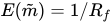
Suppose there is a risk-free asset. Then implies . Substituting this into the last expression and rearranging gives the following formula for the risk premium of any asset or portfolio with return :
This shows that risk premiums are determined by covariances with any SDF.[1]
In the Black–Scholes model, the stochastic discount factor is the stochastic process defined by,
where denotes a standard Brownian motion, is a given market price of risk, and is the Radon-Nikodym process of the risk-neutral measure with respect to the physical measure.








![{\displaystyle E_{t}[{\tilde {m}}(t+s){\tilde {x}}({t+s})]=p(t),\quad s>0}](https://wikimedia.org/api/rest_v1/media/math/render/svg/7d1d89db1c5591d2e301f18dff57cb86d6873563)
![{\displaystyle E_{t}[\;\cdot \;]=E[\;\cdot \;|{\mathcal {F}}_{t}]}](https://wikimedia.org/api/rest_v1/media/math/render/svg/1f8f1b8346bd2178bd9a681416e951a75a6247d8)



![{\displaystyle E\left[{\tilde {m}}({\tilde {R}}_{i}-{\tilde {R}}_{j})\right]=0,\quad \forall i,j.}](https://wikimedia.org/api/rest_v1/media/math/render/svg/cb2fe822f464fa73a4d4aad24a12d0b702ff5fbc)