


Rational pricing
 | This article needs additional citations for verification. (September 2025) |
In financial economics, rational pricing is the assumption that asset pricing models reflect the arbitrage-free price of the asset. This assumption is fundamental to the pricing of derivative instruments and useful in pricing fixed income securities.
According to rational pricing models, where a mismatch exists between two or more markets, arbitrage will occur such that the arbitrageur makes a risk-free profit by purchasing and short-selling simultaneously in both markets. By doing so, the arbitrageur may deliver the purchased asset to the buyer, receiving that higher price, whilst paying the seller on the cheaper market with the proceeds and pocketing the difference. As such, the law of one price holds across trading exchanges; prices of assets with identical cash flows equalise; and the price of assets with known future cash flows may be calculated in advance.
Rational pricing assumptions are a key aspect of mathematical finance and the fundamental theorem of asset pricing.
Arbitrage mechanics
[edit]Arbitrage is the practice of taking advantage of a state of imbalance between two (or possibly more) markets. Where this mismatch can be exploited (i.e. after transaction costs, storage costs, transport costs, dividends etc.) the arbitrageur can "lock in" a risk-free profit by purchasing and selling simultaneously in both markets.
In general, arbitrage ensures that "the law of one price" will hold; arbitrage also equalises the prices of assets with identical cash flows, and sets the price of assets with known future cash flows.
The law of one price
[edit]The same asset must trade at the same price on all markets ("the law of one price"). Where this is not true, the arbitrageur will:
- buy the asset on the market where it has the lower price, and simultaneously sell it (short) on the second market at the higher price
- deliver the asset to the buyer and receive that higher price
- pay the seller on the cheaper market with the proceeds and pocket the difference.
Assets with identical cash flows
[edit]Two assets with identical cash flows must trade at the same price. Where this is not true, the arbitrageur will:
- sell the asset with the higher price (short sell) and simultaneously buy the asset with the lower price
- fund his purchase of the cheaper asset with the proceeds from the sale of the expensive asset and pocket the difference
- deliver on his obligations to the buyer of the expensive asset, using the cash flows from the cheaper asset.
An asset with a known future-price
[edit]An asset with a known price in the future must today trade at that price discounted at the risk free rate.
Note that this condition can be viewed as an application of the above, where the two assets in question are the asset to be delivered and the risk free asset.
(a) where the discounted future price is higher than today's price:
- The arbitrageur agrees to deliver the asset on the future date (i.e. sells forward) and simultaneously buys it today with borrowed money.
- On the delivery date, the arbitrageur hands over the underlying, and receives the agreed price.
- He then repays the lender the borrowed amount plus interest.
- The difference between the agreed price and the amount repaid (i.e. owed) is the arbitrage profit.
(b) where the discounted future price is lower than today's price:
- The arbitrageur agrees to pay for the asset on the future date (i.e. buys forward) and simultaneously sells (short) the underlying today; he invests (or banks) the proceeds.
- On the delivery date, he cashes in the matured investment, which has appreciated at the risk free rate.
- He then takes delivery of the underlying and pays the agreed price using the matured investment.
- The difference between the maturity value and the agreed price is the arbitrage profit.
Point (b) is only possible for those holding the asset but not needing it until the future date. There may be few such parties if short-term demand exceeds supply, leading to backwardation.
Fixed-income securities
[edit]Under rational pricing models, two assets with identical cash flows must trade at the same price. Where this is not true, an arbitrageur will short the asset with the higher price and simultaneously buy the asset with the lower price. The sale of the higher priced asset funds his purchase of the cheaper asset, and the purchase of the cheaper asset allows him to deliver on his obligations to the buyer. Thus, the arbitrageur earns a risk-free profit.
The pricing formula for a fixed-income security is thus:
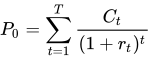
where each cash flow is discounted at the rate that matches the coupon date.


Often, the formula is expressed as
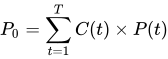
using prices instead of rates, where prices are more readily available.
Rational pricing applies also to interest rate modeling more generally. Here, yield curves in entirety must be arbitrage-free with respect to the prices of individual instruments. Investment banks, and other market makers here, thus invest considerable resources in "curve stripping".
Derivatives
[edit]As above, according to rational pricing, an asset with a known price in the future must today trade at that price discounted at the risk free rate. Where the discounted future price is higher than today's price, the arbitrageur sells forward the asset and simultaneously buys it today on margin. On the delivery date, the arbitrageur hands over the underlying, receiving the agreed price, repaying the lender the amount due, and making the profit from arbitrage. Where the discounted future price is lower than today's price, the arbitrageur buys forward the asset and simultaneously shorts the underlying today. In this case, rational pricing may not occur in situations of normal backwardation.
Under rational pricing assumptions, in a correctly priced derivative contract, the derivative price, the strike price, and the spot price will be related such that arbitrage is not possible.
Futures
[edit]In a futures contract, for no arbitrage to be possible, the forward price must be the same as the cost, including interest, of buying and storing the asset. In other words, the rational forward price represents the expected future value of the underlying discounted at the risk free rate, a condition known as spot–future parity.
Thus, for a simple, non-dividend paying asset, the value of the future/forward, , will be found by accumulating the present value at time to maturity by the rate of risk-free return :



Swaps
[edit]Rational pricing underpins the logic of swap valuation. To be arbitrage free, the terms of a swap contract are such that, initially, the net present value of these future cash flows is equal to zero, that is the present value of future swap rate payments is equal to the present value of the expected future floating rate payments.
The floating leg of an interest rate swap can be decomposed into a series of forward rate agreements. Similarly, the "receive-fixed" leg of a swap can be valued by comparison to a bond with a similar schedule of payments. Further, given that their underlyings have the same cash flows, bond options and swaptions are equatable. The difference between the interest rate cap and floor values equate to the swap value, per similar arbitrage arguments.
Options
[edit]Option pricing models assume risk neutrality and a binomial options model for the behavior of the underlying instrument, which allows for only two states – up or down. If S is the current price, then in the next period the price will either be or . In other words, , and , where u and d are multipliers (with and assuming ). Under these assumptions, the expected value is discounted and calculated using the intrinsic values these two terms with , that is, the share price is a Martingale.


Hence, to calculate the value of an option,

where p is the probability of an up move in the underlying, (1-p) is the probability of a down move, and r is the risk-free rate.
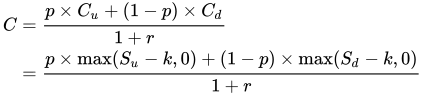
This logic underlies the Black–Scholes formula and the lattice approach in the binomial options model. However, classical valuation methods like the Black–Scholes model or the Merton model cannot account for systemic counterparty risk which is present in systems with financial interconnectedness.[1]
Delta hedging
[edit]It is possible to create a position consisting of Δ shares and 1 call sold, such that the position's value will be identical in the S up and S down states, and hence known with certainty. This is known as Delta hedging.
To solve for Δ: where is the value of position in one period, and is the strike price.


To solve for the value of the call: where is the value of position today and is the value of the call.


The replicating portfolio
[edit]It is possible to create a position consisting of Δ shares and $B borrowed at the risk free rate, which will produce identical cash flows to one option on the underlying share. The position created is known as a replicating portfolio since its cash flows replicate those of the option.
Here solve simultaneously for and B: then


There is no discounting here, as the interest rate appears only as part of the construction. This approach is therefore used in preference to others where it is not clear whether the risk free rate may be applied as the discount rate at each decision point, or whether, instead, a premium over risk free, differing by state, would be required. Under real options analysis,[2] managements' actions actually change the risk characteristics of the project in question, and hence the required rate of return could differ in the up- and down-states:

Another case where the modelling assumptions may depart from rational pricing is the valuation of employee stock options.
Shares
[edit]The arbitrage pricing theory, a general theory of asset pricing, has become influential in the pricing of shares. APT holds that the expected return of a financial asset can be modelled as a linear function of various macro-economic factors, where sensitivity to changes in each factor is represented by a factor specific beta coefficient:

- where
- is the risky asset's expected return,
- is the risk free rate,
- is the macroeconomic factor,
- is the sensitivity of the asset to factor ,
- and is the risky asset's idiosyncratic random shock with mean zero.


The model derived rate of return will then be used to price the asset correctly – the asset price should equal the expected end of period price discounted at the rate implied by model. If the price diverges, arbitrage should bring it back into line. Here, to perform the arbitrage, the investor creates a correctly priced asset (a synthetic asset), a portfolio with the same net-exposure to each of the macroeconomic factors as the mispriced asset but a different expected return.
The capital asset pricing model (CAPM) is an earlier, (more) influential theory on asset pricing. Although based on different assumptions, the CAPM can, in some ways, be considered a "special case" of the APT; specifically, the CAPM's security market line represents a single-factor model of the asset price, where beta is exposure to changes in the value of the market as a whole.
See also
[edit]- Contingent claim analysis
- Covered interest arbitrage
- Efficient-market hypothesis
- Fair value
- Homo economicus
- List of valuation topics
- No free lunch with vanishing risk
- Rational choice theory
- Rationality
- Volatility arbitrage
- Systemic risk
- Yield curve / interest rate modeling:
References
[edit]- ^ Fischer, Tom (2014). "No-Arbitrage Pricing Under Systemic Risk: Accounting for Cross-Ownership". Mathematical Finance. 24 (1): 97–124 (Published online: 19 Jun 2012). arXiv:1005.0768. doi:10.1111/j.1467-9965.2012.00526.x.
- ^ See Ch. 23, Sec. 5, in: Frank Reilly, Keith Brown (2011). "Investment Analysis and Portfolio Management." (10th Edition). South-Western College Pub. ISBN 0538482389
External links
[edit]- Arbitrage free pricing
- Pricing by Arbitrage, The History of Economic Thought Website
- "The Fundamental Theorem" of Finance; part II. Prof. Mark Rubinstein, Haas School of Business
- The Notion of Arbitrage and Free Lunch in Mathematical Finance, Prof. Walter Schachermayer
- Risk neutrality and arbitrage free pricing
- Risk-Neutral Probabilities Explained. Nicolas Gisiger
- Risk-neutral Valuation: A Gentle Introduction, Part II. Joseph Tham Duke University
- Application to derivatives
- Option Valuation in the Binomial Model (archived), Prof. Ernst Maug, Rensselaer Polytechnic Institute
- The relationship between futures and spot prices, Investment Analysts Society of Southern Africa
- Swaptions and Options, Prof. Don M. Chance