


Swansea City A.F.C.
 | ||
| Full name | Swansea City Association Football Club | |
|---|---|---|
| Nicknames | ||
| Founded | 1912, as Swansea Town | |
| Ground | Swansea.com Stadium | |
| Capacity | 21,000[2] | |
| Owner(s) | Swansea Football LLC (71.18%)Nigel Morris (12.9%)Swansea City Supporters Society Ltd (6.98%)[3] | |
| Chief executive | Tom Gorringe | |
| Head coach | Vítor Matos | |
| League | EFL Championship | |
| 2024–25 | EFL Championship, 11th of 24 | |
| Website | swanseacity | |
|
| ||


Swansea City Association Football Club (/ˈswɒnzi/ SWON-zee; Welsh: Clwb Pêl-droed Dinas Abertawe[4]) is a Welsh professional football club based in Swansea, Wales. They compete in the EFL Championship, the second tier of English football. The club was founded in 1912 as Swansea Town but changed their name in 1970 to reflect Swansea's new status as a city.[5] They have played their home matches at the Swansea.com Stadium (formerly known as the Liberty Stadium) since 2005, having previously played at the Vetch Field since their founding.
Swansea entered the Southern League in 1912 before joining the Football League in 1920. They won the Third Division South title in 1925 and 1949, but fell into the Fourth Division after relegations in 1965 and 1967. Swansea won three promotions in four seasons to reach the First Division in 1981, finishing sixth in the top flight (a club record), but were back in the Fourth Division by 1986. The club won the Third Division title in 2000 but narrowly avoided relegation to the Conference in 2003. They won their fourth league title in 2008 after winning League One.
In 2011, Swansea were promoted to the Premier League and won the League Cup two years later, qualifying for the UEFA Europa League. It was the first major trophy in the club's history; their other trophies include ten Welsh Cups, two Football League Trophies and two FAW Premier Cups. The club also qualified for the European Cup Winners' Cup seven times between 1961 and 1991. They were relegated from the Premier League in 2018, and have since played in the Championship.
Swansea's climb from the fourth division of English football to the Premier League is chronicled in the 2014 film, Jack to a King – The Swansea Story. Several players have won caps for their country while playing for the club, including for the Wales national football team.[6] The Swansea City Supporters' Trust owns shares in the club;[3] their involvement was hailed by Supporters Direct in 2012 as "the most high profile example of a supporters' trust in the direct running of a club".[7]
History
[edit]Early years (1912–1945)
[edit]
Following an increasing interest in football in the Swansea area, the town's first professional football club, Swansea Town, was established in 1912.[8][9] John William Thorpe, a local solicitor, was elected the club’s first chairman.[9] Players were recruited from around the United Kingdom and the team joined the Southern League Second Division under the club's first player-manager, Walter Whittaker.[8][9] Swansea joined several other clubs in the division, including Cardiff City, who were Swansea's first professional league opponents.[8] The match, played on 7 September 1912 at Swansea's Vetch Field, ended in a 1–1 draw with Billy Ball scoring Swansea's first goal.[8]
During their first season, Swansea won the Welsh Cup, the Welsh league and came third in the Southern League Second Division.[5] The following season, the club reached the first round proper of the FA Cup and finished fourth in the league.[5] John William Bartlett took over from Whittaker in 1914.[5] Under his leadership, the club beat reigning English champions Blackburn Rovers 1–0 in the first round of the 1914–15 FA Cup, with Swansea's goal coming from Ben Beynon.[10]
After the First World War, the football leagues were restructured and the club began to compete in the new Third Division of the Football League in 1920.[8] Swansea won their first championship in 1925 under manager Joe Bradshaw after winning the Third Division (South).[5] The following season, they reached the semi-final of the FA Cup and finished fifth in the league.[5][8] After Bradshaw left the club, Swansea were without a manager until 1927, when James Thompson was appointed.[5] The club experienced financial strain over the next few years, with players being sold for cheaper alternatives; Thompson resigned in 1931.[5] Despite this, Swansea won the Welsh Cup again in the 1931–32 season.[8] The club had further financial difficulties in the 1930s but avoided relegation under manager Neil Harris before the Second World War began.[5]
Post-war (1945–1970)
[edit].jpg)
When football resumed after the war, Swansea were relegated to the Third Division in 1947 but were promoted back to the Second Division as champions in 1949.[8] During the following seasons, Swansea saw several young players break through to the senior team, including the club's eventual captain Ivor Allchurch.[5][8] The club cultivated strong local support during this period, with high attendances at league games, such as a record home league attendance against Leeds United in 1955.[8] The club continued to struggle financially, however, but they again avoided relegation on the last day of the 1957–58 season.[8]
In 1960, Swansea played their first match in the League Cup and won the Welsh Cup the following year, qualifying for the Cup Winners' Cup. This made Swansea the first Welsh club to enter a European competition.[8] Manager Trevor Morris also led the club to the semi-final of the FA Cup in 1964, following a run which included a 2–1 away win against Liverpool in the quarter-final.[8][5] Swansea were relegated back to the Third Division the following season and the financial situation at the club became critical.[5]
Despite finishing seventeenth in the league under Glyn Davies, the club won the Welsh Cup again and qualified for their second European adventure.[5] In 1967, however, the club were relegated to the Fourth Division, the first time in the club's history.[5] Despite this, Swansea saw the highest attendance at the Vetch Field (32,796) for their game against Arsenal in the FA Cup in 1968, which Swansea lost.[8][5] Tragedy struck the club in January 1969 when players Roy Evans and Brian Purcell were killed in a car crash on the way to a game.[11]
Success and decline (1970–1986)
[edit]
After Swansea became a city in 1969, the club changed their name to Swansea City in early 1970.[5] Roy Bentley's side celebrated by securing promotion back to the Third Division.[5] After mid-table finishes at the end of the following two seasons, the club made a poor start to the 1972–73 season, which saw Bentley being replaced by Harry Gregg. Gregg failed to stop the team's decline and the club was back in the Fourth Division for the 1973–74 season.[5] He was replaced by Harry Griffiths, the club's physiotherapist who had also played for Swansea.[5] Financial issues continued to plague the club and Swansea were forced to apply for re-election to the Football League.[5][8]
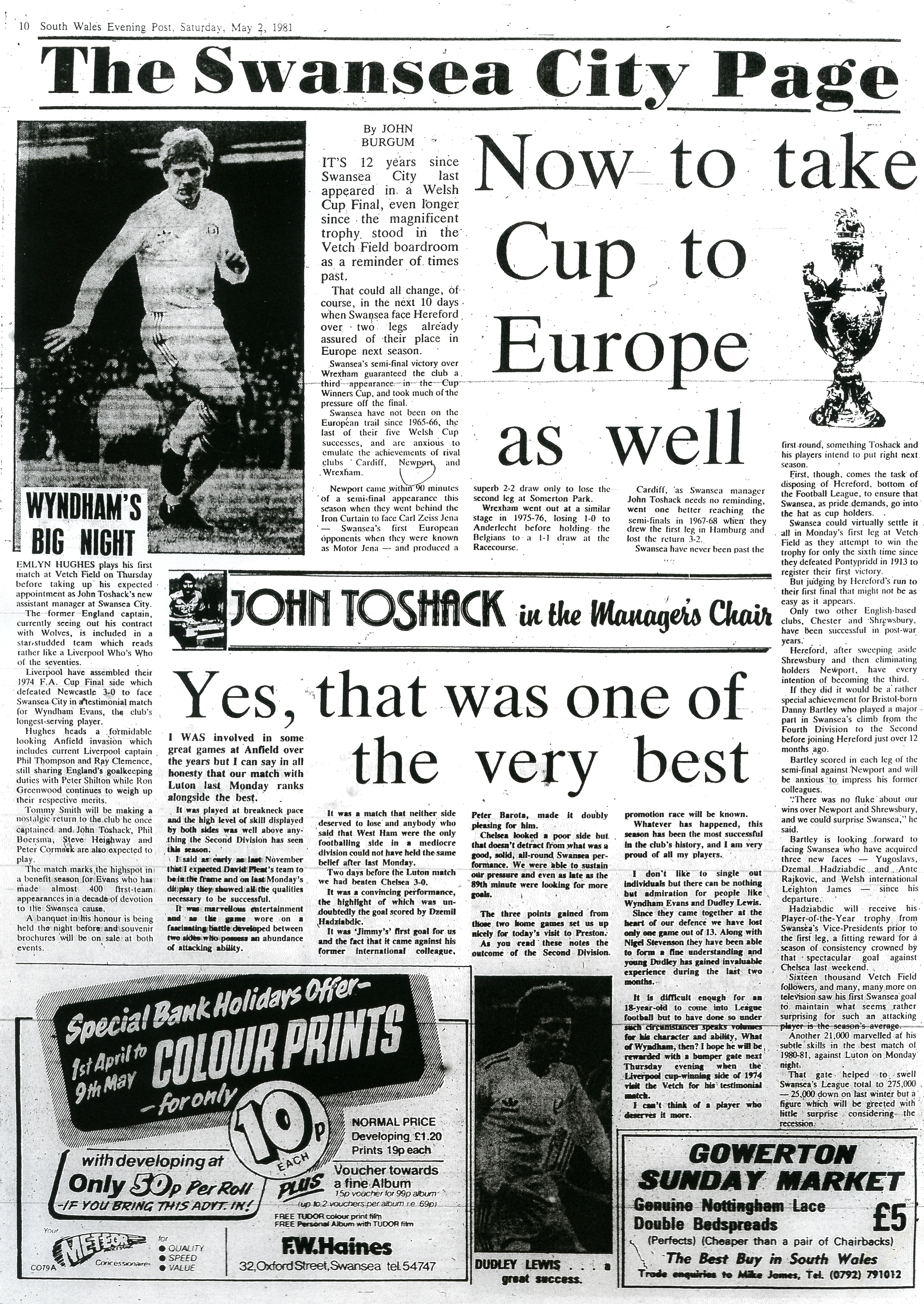
Swansea failed to win promotion in 1977, and Griffiths resigned the following year despite a positive start to the season.[5] He was replaced by John Toshack.[5] Swansea were promoted in 1978, and Toshack led the club to the Second Division the following season and the First Division in 1981.[8] They beat Preston North End 3–1 to guarantee their promotion, with goals from Tommy Craig, Leighton James and Jeremy Charles.[12][13] Swansea's four-year rise to the top division became a record in English football, held jointly with Wimbledon.[14] Swansea also won the Welsh Cup that season, qualifying for Europe for the first time since the 1965–66 season.[15]
The club's first match in the top flight was a 5–1 win against Leeds United, and they also defeated Tottenham Hotspur, Arsenal, Liverpool and Manchester United during the season.[16][5] Swansea were top of the league with twelve games to play, but finished sixth.[16] They won the Welsh Cup again to qualify for Europe.[17] Despite being relegated to the Second Division the following season, Swansea enjoyed success in Europe after defeating Braga and winning 12–0 against Sliema Wanderers, a club record result.[8] Swansea were subsequently defeated by Paris-Saint Germain.[8] Amid financial pressures, Toshack left the club in October 1983, returned eight weeks later, but left Swansea again in 1984 with the team back in the Third Division.[5]
By 1985, the club was battling for its survival and was issued a winding-up order.[16] Local people raised money for the club, and Manchester United played a friendly match which raised £45,000.[8] The club was saved by Peter Howard, Harry Hyde, Bobby Jones, Mel Nurse and Dave Savage (who came to be known as the "Famous Five"),[16] along with local businessman Doug Sharpe, although the change of ownership was not enough to prevent relegation to the Fourth Division in 1986.[18][16]
Promotions, relegations and last years at the Vetch Field (1986–2005)
[edit]Swansea were promoted from the Fourth Division in 1988 after winning the play-offs.[5] The club won the Welsh Cup again in 1989 and 1991 to qualify for Europe.[8] After a period of relative stability, Swansea reached the play-off semi-finals of the new Second Division in 1993 before making their first appearance at Wembley Stadium a year later, when they defeated Huddersfield Town to win the Football League Trophy.[5][8]
After Jan Mølby became player-manager, the club was relegated to the lowest division, although they made it to another Wembley play-off final in 1997, which they lost.[5] Chairman Sharpe sold the club, and Swansea saw several managers during this period. Following another unsuccessful play-off semi-final in 1999, Swansea won the Third Division in 2000.[8] However, the 1–1 draw at Rotherham United, which confirmed Swansea as Third Division champions, was overshadowed by the death of supporter Terry Coles, who was trampled to death by a police horse before the game.[19]
In July 2001, following relegation back to the Third Division, the club was sold to managing director Mike Lewis for £1.[8] One month later, the Swansea City Supporters' Trust was formed.[20] Lewis subsequently sold his stake to a consortium of Australian businessmen behind the Brisbane Lions football team, fronted by Tony Petty, again for £1.[20] After supporter demonstrations against Petty's management, during which he attempted to sack seven players to cut costs, the club was sold to a local consortium led by Mel Nurse.[21] Huw Jenkins was named chairman in January 2002.[22]

Swansea were also struggling on the pitch. The new ownership sought to keep the team in the Football League, and Brian Flynn was named manager in late 2002.[21][5] With the signings of new players including Roberto Martínez and Leon Britton, Flynn kept Swansea in the Football League following their victory against Hull City on the last day of the 2002–03 season.[22][5] Despite a positive start to the following season, Kenny Jackett replaced Flynn in 2004.[5] Jackett led Swansea to League One promotion in the club's final season at the Vetch Field.[5] They also won the FAW Premier Cup on the last day at the Vetch.[5]
Move to the Liberty Stadium and return to the top flight (2005–2016)
[edit]The club moved to the new Liberty Stadium in July 2005,[20] with the first league game being a 1–0 win against Tranmere Rovers.[8] In the first season at the stadium, Swansea won the Football League Trophy for the first time since 1994 and the FAW Premier Cup for a second successive year.[8][5] The club also reached the League One play-off final, but lost to Barnsley.[5]
Roberto Martínez, Swansea's former captain, replaced Jackett as manager in 2007 mid-season.[5] He led Swansea to Championship promotion as League One champions in 2008 while implementing a possession-based style of play at the club.[5][23] When Martínez left Swansea in 2009, Paulo Sousa replaced him before leaving himself in 2010.[5] Before Sousa's departure, Swansea player Besian Idrizaj suffered a heart attack while on international duty; the club retired the number 40 shirt in his memory.[24]

Brendan Rodgers replaced Sousa and led the club to the Premier League in 2011 after defeating Reading 4–2 in the play-off final, with Scott Sinclair scoring a hat-trick.[25] Swansea became the first Welsh team to play in the Premier League since its formation in 1992.[26] Ahead of their debut season, the club signed Danny Graham from Watford for a then-record fee of £3.5 million.[27] They defeated Arsenal, Liverpool and Manchester City, the eventual champions, at home during the season.[28] Swansea finished eleventh in the league, but Rodgers left to manage Liverpool at the end of the season.[29]
.svg)
Rodgers was replaced by Michael Laudrup for the 2012–13 season, which was the club's centenary season.[29] Laudrup's first league game ended in a 5–0 victory over Queens Park Rangers away at Loftus Road.[30] Swansea then beat West Ham United 3–0 at the Liberty Stadium, with Michu scoring his third goal in two games.[31] This saw Swansea top of the Premier League; it was the first time since March 1982 the team had been at the summit of the top tier.[31][13] After cup victories against Liverpool and Chelsea,[32] Swansea beat Bradford City 5–0 in the 2013 Football League Cup final, which was the biggest win in the final of the competition.[33][34] It was Swansea's first major piece of silverware in England and qualified them for the 2013–14 UEFA Europa League. Swansea finished the Premier League season in ninth place,[35] and Michu was the club's top scorer in all competitions with 22 goals.[36] That summer, they paid a club record transfer fee of £12 million for striker Wilfried Bony from Vitesse Arnhem.[37]

Swansea enjoyed initial success in Europe, beating Spanish side Valencia 3–0 at the Mestalla Stadium in September 2013.[38] Two months later, they lost the first Welsh derby in the Premier League to Cardiff City following a 1–0 defeat.[39] In February 2014, Laudrup was dismissed after poor form and accusations of financial impropriety involving his agent Bayram Tutumlu.[40] Defender Garry Monk, a Swansea player since 2004, was named as his replacement.[41] In Monk's first game, Swansea beat Cardiff 3–0 at the Liberty Stadium.[42] Despite holding Rafael Benítez's Napoli to a 0–0 draw in the first leg of the Europa League Round of 32, Swansea exited the competition after losing 3–1 in the second leg at the Stadio San Paolo on 27 February 2014.[43]
Bony was sold to Manchester City for a record sale of £25 million in January 2015, with add-ons reportedly leading to £28 million.[44] This deal eclipsed the record fee Swansea received from Liverpool for Joe Allen at £15 million.[44] At the time of the sale, Bony was the club's top scorer with 34 goals in all competitions, and the league's top scorer for the 2014 calendar year, with 20 goals.[44][45] Swansea finished eighth in the league at the end of the 2014–15 season with 56 points, their highest position and points haul for a Premier League season, and second highest finish in the top flight of all time.[46] During the season, they produced league doubles over Arsenal and Manchester United, becoming only the third team in Premier League history to do so.[47] Monk was sacked the following season after poor form and replaced by Francesco Guidolin.[5][48]
American ownership and return to the Championship (2016–present)
[edit].jpg)
In July 2016, an American consortium led by Jason Levien and Steven Kaplan bought a controlling interest in the club,[49] but chairman Huw Jenkins remained.[49] Three months later, Guidolin was sacked and replaced by Bob Bradley, which was the first time a Premier League club had hired an American manager.[50] Bradley was sacked after 85 days; he won only two of his eleven games.[51] He was replaced by Paul Clement,[52] who secured Swansea's Premier League status in May 2017.[53] A poor first half of the 2017–18 season saw Clement sacked and replaced by Carlos Carvalhal.[54][55][56] Despite consecutive league home wins against Liverpool (1–0),[57] Arsenal (3–1),[58] Burnley (1–0),[59] and West Ham (4–1),[60] Swansea were winless in their last nine league games (losing five) under Carvalhal, leaving them in eighteenth place on the final day of the season.[61] They were relegated on 13 May 2018, following a 2–1 defeat to already-relegated Stoke City.[61]
The first season back in the Championship produced a tenth place finish under new manager Graham Potter,[62] including a quarter-final appearance in the FA Cup.[63] Jenkins resigned as chairman amid criticism over the club's sale to the American consortium in 2016 and relegation from the Premier League.[64] After Potter left to manage Brighton,[65] former England U17 manager Steve Cooper replaced him.[66] In September 2019, Swansea sat at the top of the table after an unbeaten first month; this was the club's best start to a season in 41 years.[67] On the final day of the season, Swansea beat Reading 4–1 to finish sixth, moving into the play-offs ahead of Nottingham Forest on goal difference,[68] but were later defeated by Brentford in the semi-final second leg.[69]
At the end of the 2020–21 season, Swansea finished fourth in the league and secured a play-off place for a second consecutive season.[70] They progressed to the play-off final after defeating Barnsley 2–1 on aggregate, but lost to Brentford at Wembley Stadium.[71] After Cooper left the club, Russell Martin became head coach in 2021, leading the team to mid-table finishes before moving to Southampton in 2023.[72] The following seasons saw several managers hired and dismissed, with the team struggling in the league.[73][74][75] Swansea also saw changes in ownership when Levien and Kaplan sold their majority shareholding in November 2024.[76] In the following months, Real Madrid footballer Luka Modrić and American rapper Snoop Dogg joined the club's new ownership group.[77]
Stadium
[edit]

The Vetch Field was Swansea's home ground between 1912, the year the club was founded, and 2005. The ground saw a record attendance of 32,796 in a 1968 FA Cup fourth round game against Arsenal.[8] The final game at the Vetch was Swansea's win against Wrexham in the 2004–05 FAW Premier Cup.[5]
On 10 July 2005, Swansea's new home ground, the Liberty Stadium, was officially opened.[78] The first game to be played at the stadium was Swansea's friendly game against Fulham.[78] The Liberty became the first Premier League stadium in Wales when Swansea were promoted to the Premier League.[78] Aside from being the home of Swansea City, the stadium has hosted Welsh international football matches and has also been the home of the Ospreys rugby team.[79][80] It was renamed the Swansea.com Stadium on 9 August 2021, following a 10-year naming rights agreement.[81] As of September 2025, the stadium's capacity is 21,000.[2]
Rivalries
[edit].jpg)
Swansea City's main rivals are Cardiff City. Matches between the two clubs are known as the South Wales derbies. The rivalry has been described as among the most hostile in British football,[82] particularly after the 1960s.[83] In a 2009 match, referee Mike Dean was struck on the head by a coin thrown from the crowd in the 2–2 draw between the clubs.[84][85]
While Cardiff have won more derby matches, neither team had completed the league double until the 2021–22 season. During the season, Swansea won 3–0 and 4–0 to become the first side to complete the double in the derby's 110-year history.[86][87] The following season, Swansea beat Cardiff 2–0 at home and 3–2 in the away game, which marked a fourth consecutive derby win and a second consecutive league double.[88]
Swansea City and Bristol City have also been described as rivals.[89][90]
Identity
[edit]Nicknames
[edit]People from Swansea are nicknamed Jacks, a nickname also associated with the football club. According to Swansea University history professor Martin Johnes, Jack was a nickname for sailors, who would be described in other cities by their hometown, hence "Swansea Jack". A famed local canine lifeguard in the 1930s was coincidentally named Swansea Jack, helping popularise the name further. Johnes said that the association of the Jack nickname with Swansea's people and football club is evident from after World War II.[91]
Kits and crests
[edit]
Upon foundation in 1912, Swansea Town adopted white shirts and shorts due to Swansea RFC, a rugby union team.[92] Secondary colours on the home kit have predominantly been black, with orange in the 1960s and red in the 1990s and 2000s.[93] In 2012–13, the club celebrated their centenary with a copper-trimmed kit and a commemorative crest.[94]
When new owners Silver Shield took over in 1998, they changed the club crest as the bird on it was not universally recognisable as a swan, and the background was blue, the colour of rivals Cardiff City.[95] In 2021, to mark the 40th anniversary of the club's first promotion to the top flight in 1981, Swansea City reintroduced the badge that had preceded the 1998 design. Though it was not used on kits until the 1990s, it was used on stationery and merchandise in the 1980s.[96] The 1998 crest was reintroduced to kits in 2023.[97]
Kit manufacturers and sponsors
[edit]
| Period | Kit manufacturer | Shirt sponsor |
|---|---|---|
| 1975–1979 | Bukta | none |
| 1979–1981 | Adidas | |
| 1981–1984 | Patrick | |
| 1984–1985 | Hummel | Diversified Products (DP) |
| 1986–1989 | Admiral Sportswear | |
| 1989–1991 | Spall Sports | |
| 1991–1992 | none | |
| 1992–1993 | Matchwinner | ACTION |
| 1993–1995 | Gulf | |
| 1995–1996 | Le Coq Sportif | |
| 1996–1997 | South Wales Evening Post | |
| 1997–1999 | New Balance | Silver Shield |
| 1999–2000 | M&P Bikes | |
| 2000–2001 | Bergoni | Stretchout |
| 2001–2004 | The Travel House | |
| 2004–2005 | RE/MAX | |
| 2005–2007 | Macron | The Travel House |
| 2007–2008 | swansea.com | |
| 2008–2009 | Umbro | |
| 2009–2011 | 32Red | |
| 2011–2013 | Adidas | |
| 2013–2016 | GWFX | |
| 2016–2017 | Joma | BETEAST |
| 2017–2018 | LeTou | |
| 2018–2019 | Bet UK | |
| 2019–2020 | YOBET[98] | |
| 2020–2022 | Swansea University | |
| 2022–2023 | Westacres (Home) Swansea University (Away) Owens (Third) | |
| 2023–2025 | Reviva (Home) Westacres (Away and Third) | |
| 2025–present | Reviva (Home and Away) Gulf (Third) |
European record
[edit]- Swansea City's scores are given first in all scorelines.
| Season | Competition | Round | Opponent | Home | Away | Aggregate | Refs |
|---|---|---|---|---|---|---|---|
| 1961–62 | UEFA Cup Winners' Cup | Preliminary round |  Motor Jena Motor Jena
|
2–2 | 1–5 | 3–7 | [99] |
| 1966–67 | UEFA Cup Winners' Cup | First round |  Slavia Sofia Slavia Sofia
|
1–1 | 0–4 | 1–5 | [100] |
| 1981–82 | UEFA Cup Winners' Cup | First round | Lokomotive Leipzig
|
0–1 | 1–2 | 1–3 | [101] |
| 1982–83 | UEFA Cup Winners' Cup | Preliminary round |  Braga Braga
|
3–0 | 0–1 | 3–1 | [102] |
| First round |  Sliema Wanderers Sliema Wanderers
|
12–0 | 5–0 | 17–0 | [103] | ||
| Second round |  Paris Saint-Germain Paris Saint-Germain
|
0–1 | 0–2 | 0–3 | [104] | ||
| 1983–84 | UEFA Cup Winners' Cup | Preliminary round | Magdeburg
|
1–1 | 0–1 | 1–2 | [105] |
| 1989–90 | UEFA Cup Winners' Cup | First round |  Panathinaikos Panathinaikos
|
2–3 | 3–3 | 5–6 | [106] |
| 1991–92 | UEFA Cup Winners' Cup | First round | AS Monaco
|
1–2 | 0–8 | 1–10 | [107] |
| 2013–14 | UEFA Europa League | Third qualifying round |  Malmö FF Malmö FF
|
4–0 | 0–0 | 4–0 | [108] |
| Play-off round |  Petrolul Ploiești Petrolul Ploiești
|
5–1 | 1–2 | 6–3 | [109] | ||
| Group stage |  Kuban Krasnodar Kuban Krasnodar
|
1–1 | 1–1 | 2nd place | [110] | ||
 St. Gallen St. Gallen
|
1–0 | 0–1 | [110] | ||||
 Valencia Valencia
|
0–1 | 3–0 | [110] | ||||
| Round of 32 |  Napoli Napoli
|
0–0 | 1–3 | 1–3 | [111] |
Players
[edit]Current squad
[edit]- As of 1 November 2025[112]
Note: Flags indicate national team as defined under FIFA eligibility rules; some limited exceptions apply. Players may hold more than one non-FIFA nationality.
|
|


Out on loan
[edit]Note: Flags indicate national team as defined under FIFA eligibility rules; some limited exceptions apply. Players may hold more than one non-FIFA nationality.
|
|

Under-23s
[edit]Retired numbers
[edit]Note: Flags indicate national team as defined under FIFA eligibility rules; some limited exceptions apply. Players may hold more than one non-FIFA nationality.
|

Club officials and backroom staff
[edit]Club officials
[edit]Shareholders who own 10% or more of the issued share capital include Swansea Football LLC (controlled by Brett Cravatt and Jason Cohen) and Nigel Morris, while Swansea City Supporters Society Ltd is also a shareholder.[3] Luka Modrić and Snoop Dogg are co-owners and investors.[115][116]
| Position | Name |
|---|---|
| Honorary club president | Alan Curtis |
| Chief executive officer | Tom Gorringe |
| Directors | Andy Coleman Brett Cravatt Jason Cohen George Popstefanov Chris Sznewajs Tyler Morse Nigel Morris Todd Marcelle Keith English Martin Morgan Paul Meller (Supporter Director) Diane Hughes |
First-team staff
[edit]| Position | Name |
|---|---|
| Head coach | Vítor Matos |
| First-team coaches | Joe Allen Leon Britton Kristian O'Leary |
| Head of goalkeeping | Martyn Margetson |
| Head of medical | Dr. Jez McCluskey |
| Head physiotherapist | Thomas Gittoes |
| First-team kit manager | Michael Eames |
Academy staff
[edit]- As of 8 December 2025[118]
| Position | Name |
|---|---|
| Academy manager | Ryan Davies |
| Head of operations | Rebecca Gigg |
| Head of coaching | Liam McGarry |
| Under 21s coach | Anthony Wright[118] |
| Under 18s coach | Jon Beale |
| Head of youth development phase | Matthew Layton |
Managers
[edit]
Swansea City's first professional manager was Walter Whittaker, who was appointed in 1912.[5][119] In the club's first season, Whittaker led Swansea to their first Welsh Cup win.[5] The club's longest-serving manager, in terms of tenure, was Haydn Green, who held the position for eight years, four months and 14 days, spanning the entirety of World War II.[120] Trevor Morris, who oversaw the most games at Swansea, was also the first manager to lead a Welsh club in Europe, qualifying for the 1961–62 Cup Winners' Cup.[5][121]
John Toshack, Swansea City's most successful manager with three league promotions and three Welsh Cup wins, led the club to their highest league finish, sixth place in the 1981–82 First Division.[5] Appointed in February 1996, the Dane Jan Mølby became Swansea's first foreign manager and took them to the 1996–97 Division Three play-off final, which they lost.[5][122] In 2011, Swansea achieved promotion to the Premier League under Brendan Rodgers, becoming the first Welsh team to play in the division since its formation in 1992.[123] During the club's centenary year (2012–13), they won the League Cup for the first time under Michael Laudrup, the first major English trophy in Swansea's 100-year history.[124]
Records and statistics
[edit]
Wilfred Milne holds the record for Swansea appearances, having played 586 matches between 1920 and 1937, closely followed by Roger Freestone with 563 between 1991 and 2004.[125] The player who has won the most international caps while at the club is Ashley Williams with 50 for Wales.
The goalscoring record is held by Ivor Allchurch, with 166 goals, scored between 1947 and 1958 and between 1965 and 1968.[126] Cyril Pearce holds the record for the most league goals scored in a season, in 1931–32, with 35 league goals in the Second Division.[127][128]
The club's widest victory margin was 12–0, a scoreline which they achieved once in the European Cup Winners' Cup, against Sliema in 1982.[128][129] They have lost by an eight-goal margin on two occasions, once in the FA Cup, beaten 0–8 by Liverpool in 1990 and once in the European Cup Winners' Cup, beaten 0–8 by AS Monaco in 1991.[130] Swansea's 8–1 win against Notts County in the FA Cup in 2018 is their largest winning margin of the competition, and the largest winning margin at their home ground, the Liberty Stadium.[131]
Swansea's home attendance record was set at the fourth round FA Cup tie against Arsenal on 17 February 1968, with 32,796 fans attending the Vetch Field.[132] The club broke their transfer record to re-sign André Ayew from West Ham United in January 2018 for a fee of £18 million.[133] The most expensive sale is Gylfi Sigurðsson who joined Everton in August 2017 for a fee believed to be £45 million.[134][135]
Honours
[edit]
Swansea City's first trophy was the Welsh Cup, which they won as Swansea Town in 1913. Their first league honour came in 1925, when they won the 1924–25 Football League Third Division South title. Since then, Swansea have gone on to win the League Cup once, the Football League Trophy twice and the Welsh Cup a further nine times. They have also qualified for UEFA Cup Winners' Cup seven times and the UEFA Europa League once.
Swansea City's honours include the following:[136]
League
- Second Division / Championship (level 2)
- Third Division South / Third Division / League One (level 3)
- Fourth Division / Third Division / League Two (level 4)
Cup
References
[edit]- ^ "Yr un hen stori i'r Elyrch" (in Welsh). 14 January 2017 – via www.bbc.co.uk.
- ^ a b "Our stadium". Swansea City Events. Retrieved 12 September 2025.
- ^ a b c d "Ownership statement". Swansea City. Retrieved 24 November 2024.
- ^ "Ystafell arbennig yn rhoi cyfle i bobl ag anghenion ychwanegol wylio pêl-droed byw". newyddion.s4c.cymru (in Welsh). 22 January 2025.
- ^ a b c d e f g h i j k l m n o p q r s t u v w x y z aa ab ac ad ae af ag ah ai aj ak al am an ao ap aq ar "Our managers". Swansea City. Retrieved 6 September 2025.
- ^ "The Cymru connection – Swans on the biggest stage". FAW Cymru. 21 August 2025. Retrieved 12 September 2025.
- ^ "Swansea City fans a major influence as government encourages role of supporters' trusts". WalesOnline. 19 February 2012. Archived from the original on 16 July 2012.
- ^ a b c d e f g h i j k l m n o p q r s t u v w x y z "A history of the club". Swans100.com. Retrieved 6 September 2025.
- ^ a b c "On this day Swansea City is formed". Swansea City. Retrieved 6 September 2025.
- ^ Jenkins, John M.; et al. (1991). Who's Who of Welsh International Rugby Players. Wrexham: Bridge Books. p. 20. ISBN 978-1-872424-10-1.
- ^ "Nigel's WebSpace – English Football Cards, Player death notices".
- ^ "On this day: Promotion at Preston". Swansea City. Retrieved 14 September 2025.
- ^ a b "Swansea City's 1981 promotion glory: Toshack, Shankly, Deepdale drama and a giant headline". BBC Sport. 2 May 2021. Retrieved 14 September 2025.
- ^ "The wait ends for Lyon and Hull". fifa.com. Fédération Internationale de Football Association. 28 May 2008. Archived from the original on 12 November 2012. Retrieved 17 February 2012.
- ^ Burgum, John (2 May 1981). "Now to take Cup to Europe as well". South Wales Evening Post. Archived from the original on 13 January 2015. Retrieved 13 January 2015.
- ^ a b c d e "When Swansea City were relegated through all four divisions in four years". The Guardian. 12 May 2018. Retrieved 14 September 2025.
- ^ "JD Welsh Cup – the Legends who Lifted the Trophy". FAW Cymru. 1 March 2023. Retrieved 14 September 2025.
- ^ Moseley, Roy (30 December 1985). "More will follow Swansea down drain". Chicago Tribune.
- ^ "Swansea City remember Terry Coles". Swansea City. Retrieved 7 September 2025.
- ^ a b c "History of the Swans Trust". Swansea City Supporters' Trust. Retrieved 7 September 2025.
- ^ a b "Tony Petty era 'galvanised' Swansea's rise to Premier". BBC. 15 August 2011. Retrieved 7 September 2025.
- ^ a b "Swansea chairman Huw Jenkins took job because he was 'dull'". BBC Sport. 22 February 2013. Retrieved 7 September 2025.
- ^ "CHRIS DAVIES". Coaches' Voice. Retrieved 7 September 2025.
- ^ "Ten years on...Swansea City pay tribute to Besian Idrizaj". Swansea City. Retrieved 7 September 2025.
- ^ McCarra, Kevin (30 May 2011). "Swansea reach Premier League thanks to Scott Sinclair hat-trick". The Guardian. London. Retrieved 31 May 2011.
- ^ "Swansea City rise from rags to Premier League riches". BBC Sport. 31 May 2011. Retrieved 24 August 2020.
- ^ "Swansea complete signing of Danny Graham". The Independent. 7 June 2011. Archived from the original on 26 May 2022. Retrieved 24 August 2020.
- ^ "Swansea City Results 2011/12". Sky Sports. Retrieved 24 August 2020.
- ^ a b "Michael Laudrup named new Swansea City manager". BBC Sport. 15 June 2012. Retrieved 24 August 2020.
- ^ "QPR 0–5 Swansea". BBC Sport. 18 August 2012. Retrieved 24 August 2020.
- ^ a b "Swansea 3–0 West Ham". BBC Sport. 25 August 2012. Retrieved 24 August 2020.
- ^ "History Makers 2013 League Cup The Final". Swansea City. Retrieved 12 September 2025.
- ^ McNulty, Phil (25 February 2013). "Bradford 0–5 Swansea". Wembley: BBC Sport. Retrieved 17 May 2018.
- ^ "Swansea City romp to record win". BBC News. 25 February 2013. Retrieved 26 February 2013.
- ^ "On this day: Laudrup becomes boss". Swansea City. Retrieved 7 September 2025.
- ^ a b "Swansea City AFC statistics". Premier League. Retrieved 22 August 2020.
- ^ "Bony's the boy for Swans". Swansea City. 11 July 2013. Retrieved 12 July 2013.
- ^ "Swansea City humbled 10-man Valencia as the Welsh club began their Europa League group campaign in style". BBC Sport. 19 September 2013. Retrieved 16 May 2017.
- ^ "Cardiff City 1–0 Swansea City". BBC Sport. 3 November 2013.
- ^ "Laudrup's agent 'profited from Swansea deals'". 5 December 2016.
- ^ "Swansea sack Michael Laudrup and place Garry Monk in charge". BBC Sport. 4 February 2014. Retrieved 16 February 2014.
- ^ "Swansea City 3–0 Cardiff City". BBC Sport. 8 February 2014.
- ^ "Napoli 3–1 Swansea". BBC Sport. Retrieved 6 July 2018.
- ^ a b c "Wilfried Bony: Man City complete signing of Swansea striker". BBC Sport. Retrieved 6 July 2018.
- ^ "Swansea's Wilfried Bony joins Al-Arabi on loan until end of the season". Sky Sports. 31 January 2019. Retrieved 24 August 2020.
- ^ "10 things we learned from Swansea City's brilliant record-breaking Premier League season". Wales Online. 25 May 2015. Retrieved 6 July 2018.
- ^ "Arsenal 0–1 Swansea". BBC Sport. 11 May 2015. Retrieved 17 May 2018.
- ^ "Swansea City part company with Garry Monk".
- ^ a b "Steve Kaplan and Jason Levien: Meet Swansea City's US Owners". BBC Sport. Retrieved 24 October 2016.
- ^ "Swansea sack Francesco Guidolin and appoint Bob Bradley manager". BBC Sport. 3 October 2016.
- ^ "Swansea sack manager Bob Bradley after 11 games in charge".
- ^ "Paul Clement: Bayern Munich assistant agrees deal to be Swansea City boss". BBC News. 2 January 2017. Retrieved 2 January 2017.
- ^ "Swansea City survive in Premier League after Hull lose at Crystal Palace". BBC News. 14 May 2017.
- ^ "Carvalhal named Swans boss". Swansea City. 28 December 2017.
- ^ "Paul Clement: Swansea sack manager after less than a year in charge". BBC Sport. 20 December 2017. Retrieved 20 December 2017.
- ^ "Muddled moves and a woeful window – how Swansea landed back in trouble". The Guardian. 3 November 2017. Retrieved 4 November 2017.
- ^ "Swansea City 1–0 Liverpool". BBC Sport. 22 January 2018. Retrieved 8 February 2018.
- ^ "Swansea City 3–1 Arsenal". BBC Sport. 30 January 2018. Retrieved 8 February 2018.
- ^ "Swansea City 1–0 Burnley". BBC Sport. 10 February 2018. Retrieved 17 May 2018.
- ^ "Swansea City 4–1 West Ham United". BBC Sport. 3 March 2018. Retrieved 17 May 2018.
- ^ a b "Swansea City 1–2 Stoke City". BBC Sport. 13 May 2018. Retrieved 17 May 2018.
- ^ "Graham Potter named new Swansea City manager". BBC Sport. 11 June 2018. Retrieved 11 June 2018.
- ^ "Swansea City 2-3 Manchester City". BBC Sport. 16 March 2019. Retrieved 7 September 2025.
- ^ "Swansea City chairman Huw Jenkins resigns". BBC Sport. 2 February 2019. Retrieved 2 February 2019.
- ^ "Graham Potter appointed new Brighton manager after leaving Swansea". BBC Sport. 20 May 2019.
- ^ "England under-17 coach Steve Cooper named Swansea City boss". BBC Sport. 13 June 2019. Retrieved 20 July 2019.
- ^ "Steve Cooper: That was our best performance yet". Swansea City. 15 August 2019. Retrieved 29 September 2019.
- ^ Pritchard, Dafydd (22 July 2020). "Reading 1–4 Swansea". BBC Sport. Retrieved 23 July 2020.
- ^ Doyle, Paul (29 July 2020). "Brentford v Swansea: Championship play-off semi-final, second leg – as it happened". The Guardian. ISSN 0261-3077. Retrieved 29 July 2020.
- ^ "Watford 2–0 Swansea". BBC Sport. 8 May 2021. Retrieved 8 May 2021.
- ^ "Brentford 2-0 Swansea City". BBC Sport. 29 May 2021. Retrieved 19 June 2021.
- ^ "Russell Martin: Southampton name Swansea City boss as new manager". BBC Sport. 21 June 2023. Retrieved 17 May 2024.
- ^ Vincent, Gareth (7 May 2024). "Big summer after hard year - Swansea season review". BBC Sport. Retrieved 17 May 2024.
- ^ "Luke Williams: Head coach leaves Swansea City after slump in form". BBC Sport. 17 February 2025. Retrieved 17 February 2025.
- ^ "Sheehan sacked as Swansea City head coach". BBC Sport. 11 November 2025. Retrieved 12 November 2025.
- ^ "Swansea chairman hails 'new era' as takeover completed". BBC Sport. 23 November 2024. Retrieved 6 September 2025.
- ^ "Snoop Dogg becomes Swansea co-owner and investor". BBC Sport. 17 July 2025. Retrieved 6 September 2025.
- ^ a b c "On this day: The Liberty era begins". swanseacity.com. Swansea City. Retrieved 12 September 2025.
- ^ "Swansea has previous for hosting Wales internationals". Belfast Telegraph. 27 March 2020. Retrieved 12 September 2025.
- ^ "Ospreys choose St Helen's as new stadium home". BBC Sport. 8 July 2024. Retrieved 12 September 2025.
- ^ "SWANSEA.COM BECOME STADIUM NAMING RIGHTS PARTNER". Swansea City. 9 August 2021. Retrieved 9 August 2021.
- ^ "Welsh rivals are upwardly mobile". BBC Sport. 2 April 2009. Retrieved 19 May 2009.
- ^ HanesCymru (26 July 2017). "A Supporters' History of the South Wales Derby". 100 Years of Swansea City FC. Retrieved 21 August 2017.
- ^ "Cardiff 2–2 Swansea". BBC Sport. 5 April 2009. Retrieved 19 May 2009.
- ^ "Cardiff v Swansea: Mike Dean to referee derby game". BBC Sport. 28 October 2013. Retrieved 12 September 2025.
- ^ "Swansea City 3–0 Cardiff City". BBC Sport. 17 October 2021. Retrieved 2 April 2022.
- ^ "Cardiff City 0–4 Swansea City". BBC Sport. 2 April 2022. Retrieved 2 April 2022.
- ^ "Cardiff City 2-3 Swansea City: Ben Cabango's late goal seals Swans' fourth-straight derby win". BBC Sport. 1 April 2023. Retrieved 12 September 2025.
- ^ "Bristol City predicted team vs Swansea City: Manning to face selection headache over decisions". 29 September 2024. Retrieved 12 September 2025.
- ^ "How Ryan Reynolds and Wrexham could make Welsh 'rivalry' with Swansea City stronger than ever". 12 July 2025. Retrieved 12 September 2025.
- ^ Bannon, Christie (24 December 2018). "The real meanings behind the Welsh nicknames we all use". Wales Online. Retrieved 17 May 2024.
- ^ "Swansea City FC: What do you know about the club?". BBC News. 23 February 2013. Retrieved 17 May 2024.
- ^ Rogers, Gareth (20 June 2014). "Swansea City's kit through the years". Wales Online. Retrieved 17 May 2024.
- ^ "Swansea City channel Real Madrid with centenary home shirt". Wales Online. 11 June 2012. Retrieved 17 May 2024.
- ^ Williams, Nino (20 September 2018). "The story of how Swansea City got their club logo and the man who designed it". Wales Online. Retrieved 17 May 2024.
- ^ "Swansea City unveil new crest celebrating top-flight anniversary". BBC Sport. 30 June 2021. Retrieved 17 May 2024.
- ^ James, Ben (16 June 2023). "New Swansea City kits and badge unveiled for 2023/24 season". Wales Online. Retrieved 17 May 2024.
- ^ "YOBET debuts as Swansea City's new front of shirt sponsor". swanseacity.com. 2 July 2019. Retrieved 2 July 2019.
- ^ "1961–62 UEFA Cup Winners' Cup Preliminary Round Results". UEFA. UEFA. 16 January 2009. Archived from the original on 13 November 2010. Retrieved 15 July 2013.
- ^ "1966–67 UEFA Cup Winners' Cup First Round Results". UEFA. UEFA. 16 January 2009. Archived from the original on 30 June 2010. Retrieved 15 July 2013.
- ^ "1981–82 UEFA Cup Winners' Cup First Round Results". UEFA. UEFA. 16 January 2009. Archived from the original on 5 January 2013. Retrieved 15 July 2013.
- ^ "1982–83 UEFA Cup Winners' Cup Preliminary Round Results". UEFA. UEFA. 16 January 2009. Archived from the original on 17 July 2013. Retrieved 15 July 2013.
- ^ "1982–83 UEFA Cup Winners' Cup First Round Results". UEFA. UEFA. 16 January 2009. Archived from the original on 5 January 2013. Retrieved 15 July 2013.
- ^ "1982–83 UEFA Cup Winners' Cup Second Round Results". UEFA. UEFA. 16 January 2009. Archived from the original on 17 July 2013. Retrieved 15 July 2013.
- ^ "1983–84 UEFA Cup Winners' Cup Preliminary Round Results". UEFA. UEFA. 16 January 2009. Archived from the original on 17 July 2013. Retrieved 15 July 2013.
- ^ "1989–90 UEFA Cup Winners' Cup First Round Results". UEFA. UEFA. 16 January 2009. Archived from the original on 5 January 2013. Retrieved 15 July 2013.
- ^ "1991–92 UEFA Cup Winners' Cup First Round Results". UEFA. UEFA. 16 January 2009. Archived from the original on 5 January 2013. Retrieved 15 July 2013.
- ^ "2013–14 UEFA Europa League third qualifying round results". UEFA. UEFA. 8 August 2013. Archived from the original on 29 June 2013. Retrieved 22 August 2013.
- ^ "2013–14 UEFA Europa League play-off results". UEFA. UEFA. 22 August 2013. Archived from the original on 29 June 2013. Retrieved 22 August 2013.
- ^ a b c "2013–14 UEFA Europa League group stage results". UEFA. UEFA. 7 September 2013. Archived from the original on 29 June 2013. Retrieved 7 September 2013.
- ^ "2013–14 UEFA Europa League Round of 32". UEFA. UEFA. 20 February 2014. Archived from the original on 13 February 2014. Retrieved 20 February 2014.
- ^ "First team". Swansea City A.F.C. Retrieved 23 September 2019.
- ^ "Swansea City retire number 40 shirt". Swansea City A.F.C. 17 May 2010. Archived from the original on 2 October 2013. Retrieved 26 September 2012.
- ^ a b "Swansea City Contact List". Swansea City. Retrieved 20 July 2019.
- ^ "Real Madrid's Luka Modric becomes part-owner at 'incredible' Swansea". The Guardian. 14 April 2025.
- ^ "Snoop Dogg becomes Swansea co-owner and investor". BBC Sport. 17 July 2025. Retrieved 17 July 2025.
- ^ "Swansea City: First Team Staff". Swansea City. 20 July 2019.
- ^ a b "Academy Staff". Swansea City. Retrieved 31 October 2023.
- ^ Jones, Colin (2012). Swansea Town & City Football Club: The Complete Record, 1912–2012. From Southern League to Premier League (1st ed.). Dinefwr Press Ltd. pp. 1–8. ISBN 978-1904323-26-6.
- ^ Jones, Colin (2012). Swansea Town & City Football Club: The Complete Record, 1912–2012. From Southern League to Premier League (1st ed.). Dinefwr Press Ltd. pp. 109–137. ISBN 978-1904323-26-6.
- ^ "Trevor Morris". soccerbase.com. Retrieved 4 February 2013.
- ^ "Jan Molby". soccerbase.com. Retrieved 4 February 2013.
- ^ "Reading 2–4 Swansea". BBC Sport. 30 May 2011. Retrieved 14 July 2013.
- ^ James, Stuart (24 February 2013). "Michael Laudrup acclaims Swansea League Cup win as a career pinnacle". The Guardian. London. Retrieved 14 July 2013.
- ^ Jones, Colin (2005). Swansea Town/City FC: The First Comprehensive Player A-Y. Parthian Books. ISBN 978-1902638751.
- ^ Rollin, Glenda; Rollin, Jack (1999). Rothmans Football Yearbook 1999–2000. Headline Book Publishing. pp. 354–355. ISBN 0-7472-7627-7.
- ^ "Centenary feature: 1931-1939". Swansea City. Retrieved 12 September 2025.
- ^ a b "Facts and figures". Swansea City. Retrieved 12 September 2025.
- ^ "Swansea City AFC Club Record in UEFA Competitions". UEFA. UEFA. Retrieved 15 July 2013.
- ^ "Swansea Statto.com Records Competitions". statto.com. 28 May 2013.
- ^ "Swansea City 8–1 Notts County". BBC Sport. 6 February 2018. Retrieved 7 February 2018.
- ^ Jones, Colin (2012). Swansea Town & City Football Club: The Complete Record, 1912–2012. From Southern League to Premier League (1st ed.). Dinefwr Press Ltd. p. 245. ISBN 978-1904323-26-6.
- ^ "Andre Ayew: Swansea City re-sign Ghana forward from West Ham". BBC Sport. 31 January 2018. Retrieved 7 February 2018.
- ^ "Swansea City midfielder Gylfi Sigurdsson has completed a club-record transfer to Everton". Swansea City. 16 August 2017. Retrieved 16 August 2017.
- ^ "Gylfi Sigurdsson: Everton sign Swansea midfielder for £45m". BBC Sport. 16 August 2017. Retrieved 20 December 2017.
- ^ "Honours". swanseacity.com. Swansea City A.F.C. Retrieved 9 September 2025.
External links
[edit]
- Official website
- Swans Academy (Archived 6 February 2015 at the Wayback Machine) – Official Swansea City academy site
- Swans Commercial – Official Swansea City commercial site
Independent sites
[edit]- Swansea City Supporters' Trust
- Swansea Independent[dead link]
- Planet Swans
- Swansea City at the Premier League official website
- Forza Swansea
- Latest Swansea City News and Video. Archived 15 July 2019 at the Wayback Machine.
- Swans100: 100 Years of Swansea City AFC
| Players | |
|---|---|
| Home stadium |
|
| Training ground | |
| Other teams | |
| Media | |
| Rivalries | |
| Related articles | |



- Swansea City A.F.C.
- Football clubs in Wales
- English Football League clubs
- Association football clubs established in 1912
- Sport in Swansea
- Welsh football clubs in English leagues
- Southern Football League clubs
- EFL Trophy winners
- 1912 establishments in Wales
- EFL Cup winners
- Premier League clubs
- Welsh Cup winners
- Football clubs in Swansea
- Professional football clubs in Wales