


Conformal radius
 | This article needs additional citations for verification. (November 2025) |
In mathematics, the conformal radius is a way to measure the size of a simply connected planar domain D viewed from a point z in it. As opposed to notions using Euclidean distance (say, the radius of the largest inscribed disk with center z), this notion is well-suited to use in complex analysis, in particular in conformal maps and conformal geometry.
A closely related notion is the transfinite diameter or (logarithmic) capacity of a compact simply connected set D, which can be considered as the inverse of the conformal radius of the complement E = Dc viewed from infinity.
Definition
[edit]Given a simply connected domain D ⊂ C, and a point z ∈ D, by the Riemann mapping theorem there exists a unique conformal map f: D → D onto the unit disk (usually referred to as the uniformizing map) with f(z) = 0 ∈ D and f′(z) ∈ R+. The conformal radius of D from z is then defined as
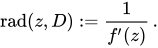
The simplest example is that the conformal radius of the disk of radius r viewed from its center is also r, shown by the uniformizing map x ↦ x/r. See below for more examples.
One reason for the usefulness of this notion is that it behaves well under conformal maps: if φ: D → D′ is a conformal bijection and z in D, then .

The conformal radius can also be expressed as where is the harmonic extension of from to .


A special case: the upper-half plane
[edit]Let K ⊂ H be a subset of the upper half-plane such that D:= H\K is connected and simply connected, and let z ∈ D be a point. (This is a usual scenario, say, in the Schramm–Loewner evolution). By the Riemann mapping theorem, there is a conformal bijection g: D → H. Then, for any such map g, a simple computation gives that
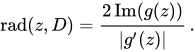
For example, when K = ∅ and z = i, then g can be the identity map, and we get rad(i, H) = 2. Checking that this agrees with the original definition: the uniformizing map f : H → D is
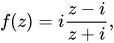
and then the derivative can be easily calculated.
Relation to inradius
[edit]That it is a good measure of radius is shown by the following immediate consequence of the Schwarz lemma and the Koebe 1/4 theorem: for z ∈ D ⊂ C,

where dist(z, ∂D) denotes the Euclidean distance between z and the boundary of D, or in other words, the radius of the largest inscribed disk with center z.
Both inequalities are best possible:
- The upper bound is clearly attained by taking D = D and z = 0.
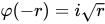
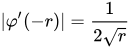
- The lower bound is attained by the following “slit domain”: D = C\R+ and z = −r ∈ R−. The square root map φ takes D onto the upper half-plane H, with and derivative . The above formula for the upper half-plane gives , and then the formula for transformation under conformal maps gives rad(−r, D) = 4r, while, of course, dist(−r, ∂D) = r.

Version from infinity: transfinite diameter and logarithmic capacity
[edit]When D ⊂ C is a connected, simply connected compact set, then its complement E = Dc is a connected, simply connected domain in the Riemann sphere that contains ∞,[citation needed] and one can define

where f : C\D → E is the unique bijective conformal map with f(∞) = ∞ and that limit being positive real, i.e., the conformal map of the form

The coefficient c1 = rad(∞, D) equals the transfinite diameter and the (logarithmic) capacity of D; see Chapter 11 of Pommerenke (1975)[1] and Kuz′mina (2002).[2]
The coefficient c0 is called the conformal center of D. It can be shown to lie in the convex hull of D; moreover,

where the radius 2c1 is sharp for the straight line segment of length 4c1. See pages 12–13 and Chapter 11 of Pommerenke (1975).[1]
The Fekete, Chebyshev and modified Chebyshev constants
[edit]We define three other quantities that are equal to the transfinite diameter even though they are defined from a very different point of view. Let

denote the product of pairwise distances of the points and let us define the following quantity for a compact set D ⊂ C:


In other words, is the supremum of the geometric mean of pairwise distances of n points in D. Since D is compact, this supremum is actually attained by a set of points. Any such n-point set is called a Fekete set.

The limit exists and it is called the Fekete constant.

Now let denote the set of all monic polynomials of degree n in C[x], let denote the set of polynomials in with all zeros in D and let us define


- and


Then the limits
- and


exist and they are called the Chebyshev constant and modified Chebyshev constant, respectively. Michael Fekete and Gábor Szegő proved that these constants are equal.[citation needed]
Applications
[edit]The conformal radius is a very useful tool, e.g., when working with the Schramm–Loewner evolution. A beautiful instance can be found in Lawler, Schramm & Werner (2002).[3]
References
[edit]- ^ a b Pommerenke, Christian (1975). Univalent functions. Studia Mathematica/Mathematische Lehrbücher. Vol. Band XXV. With a chapter on quadratic differentials by Gerd Jensen. Göttingen: Vandenhoeck & Ruprecht. Zbl 0298.30014.
- ^ Kuz′mina, G. V. (2002) [1994], "Conformal radius of a domain", Encyclopedia of Mathematics, EMS Press
- ^ Lawler, Gregory; Schramm, Oded; Werner, Wendelin (2002-01-01). "One-Arm Exponent for Critical 2D Percolation". Electronic Journal of Probability. 7 (none). doi:10.1214/EJP.v7-101. ISSN 1083-6489.
- Ahlfors, Lars V. (1973). Conformal invariants: topics in geometric function theory. Series in Higher Mathematics. McGraw-Hill. ISBN 978-0-07-000659-1. MR 0357743. Zbl 0272.30012.
- Horváth, János, ed. (2005). A Panorama of Hungarian Mathematics in the Twentieth Century, I. Bolyai Society Mathematical Studies. Springer. ISBN 3-540-28945-3.
Further reading
[edit]- Rumely, Robert S. (1989), Capacity theory on algebraic curves, Lecture Notes in Mathematics, vol. 1378, Berlin etc.: Springer-Verlag, ISBN 3-540-51410-4, Zbl 0679.14012
External links
[edit]- Pooh, Charles, Conformal radius. From MathWorld — A Wolfram Web Resource, created by Eric W. Weisstein.