


Exner function
The Exner function is a parameter used in atmospheric modeling. Depending on the application, the Exner function may be defined as

or as a non-dimensional form
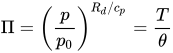
where is a standard reference surface pressure (usually taken as 1000 hPa, but sometimes as the surface pressure); is the specific gas constant for dry air; is the specific heat capacity of dry air at constant pressure; is the absolute temperature; and is the potential temperature.[1][2][3] The non-dimensional form can be used as a vertical coordinate in some numerical weather prediction applications, resulting in a simpler mathematical formulation compared to using pressure as the vertical coordinate.[2] It is named after Felix Maria von Exner-Ewarten.[4]


References
[edit]- ^ Holton, James R. (2004). An Introduction to Dynamic Meteorology. Burlington, MA: Elsevier Academic Press. p. 109. ISBN 978-0-12-354015-7. Retrieved 2025-11-18.
- ^ a b Bluestein, Howard B. (2013). Severe Convective Storms and Tornadoes. London: Springer-Verlag. pp. 60–61. ISBN 978-3-642-05381-8. Retrieved 2025-11-18.
- ^ "CF Standard Name Table". CF Metadata Conventions. 2025-07-24. Retrieved 2025-11-18.
The term "Exner function" is applied to various quantities in the literature. "Dimensionless Exner function" is the standard name of (p/p0)^(R/Cp), where p is pressure, p0 a reference pressure, R the gas constant and Cp the specific heat at constant pressure. This quantity is also the ratio of in-situ to potential temperature.
- ^ Koertge, Noretta (2008). "EXNER-EWARTEN, FELIX MARIA VON" (PDF). New Dictionary of Scientific Biography. Retrieved 2025-11-18.
See also
[edit]- Barometric formula
- Climate model
- Euler equations
- Fluid dynamics
- General circulation model
- Numerical weather prediction
- Primitive equations
 | This article about atmospheric science is a stub. You can help Wikipedia by expanding it. |