


Exponential hierarchy
In computational complexity theory, the exponential hierarchy is a hierarchy of complexity classes that is an exponential time analogue of the polynomial hierarchy. As elsewhere in complexity theory, “exponential” is used with two different meanings (linear exponential bounds for a constant c, and full exponential bounds ), leading to two versions of the exponential hierarchy.[1][2] These hierarchies are sometimes also referred to as the weak exponential hierarchies, to differentiate them from the strong exponential hierarchy, which contains both of the weak hierarchies.[2][3]


EH
[edit]The complexity class EH is the union of the classes for all k, where and (i.e., languages computable in nondeterministic time for some constant c with a oracle). One also defines


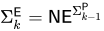

- and
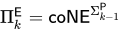

An equivalent definition is that a language L is in if and only if it can be written in the form

where is a predicate computable in time (which implicitly bounds the length of yi). Also equivalently, EH is the class of languages computable on an alternating Turing machine in time for some c with constantly many alternations.


EXPH
[edit]EXPH is the union of the classes , where (languages computable in nondeterministic time for some constant c with a oracle), , and again:

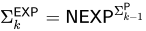
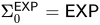

A language L is in if and only if it can be written as
where is computable in time for some c, which again implicitly bounds the length of yi. Equivalently, EXPH is the class of languages computable in time on an alternating Turing machine with constantly many alternations.


The strong exponential hierarchy
[edit]The strong exponential hierarchy, denoted SEH, is the union of NE, NPNE, NPNPNE, and so on.[4]
The same class is obtained if we replace NE by NEXP.[4]
Comparison
[edit] |
References
[edit]- ^ Sarah Mocas, Separating classes in the exponential-time hierarchy from classes in PH, Theoretical Computer Science 158 (1996), no. 1–2, pp. 221–231.
- ^ a b Anuj Dawar, Georg Gottlob, Lauri Hella, Capturing relativized complexity classes without order, Mathematical Logic Quarterly 44 (1998), no. 1, pp. 109–122.
- ^ Hemachandra, Lane A. (1989). "The strong exponential hierarchy collapses". Journal of Computer and System Sciences. 39 (3): 299–322. doi:10.1016/0022-0000(89)90025-1.
- ^ a b https://complexityzoo.net/Complexity_Zoo:S#seh