


Talk:Binomial theorem/Archive 1
 | This is an archive of past discussions about Binomial theorem. Do not edit the contents of this page. If you wish to start a new discussion or revive an old one, please do so on the current talk page. |
| Archive 1 |
propose adding stats application
Let p be the probability of a discrete event taking place. The probability of the event not taking place is 1-p. Let 1-p = q. Then in a series of n trials the probabilty of p taking place r times is
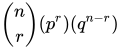
—Preceding unsigned comment added by 212.159.75.167 (talk • contribs) 17:12, 3 January 2007
- This is all covered in a separate article titled binomial distribution. Michael Hardy 00:58, 4 January 2007 (UTC)
simplification
"whenever n is any non-negative integer"
could read
"when n is a natural number"
—Preceding unsigned comment added by 212.159.75.167 (talk • contribs) 17:16, 3 January 2007
- Unfortunately some mathematicians define "natural number" to mean positive integer (0 is not included) and others (especially logicians and set-theorists) define it to mean nonnegative integer (0 is included). So it's ambiguous. Michael Hardy 00:59, 4 January 2007 (UTC)
- whenever n is any non-negative integer
- this sentence is useless, since the factorial is defined for all complex numbers, except for the negative integers (in which case it is ssaid to be (unsigned) infinity. —Preceding unsigned comment added by 134.184.49.146 (talk • contribs) 05:07, 2 March 2007
What if x = 0 ?
if x is 0, the left side of the equation turns into yn but the left side goes to 0.... that doesn't make sense Fresheneesz 22:07, 10 January 2007 (UTC)
- When using the binomial theorem it is customary to define to be equal to 1 (see Exponentiation#Zero_to_the_zero_power).
- —Preceding unsigned comment added by 213.200.162.130 (talk • contribs) 12:54, 13 January 2007

Pascal's Triangle
I had this explained to me through the showing of Pascal's Traingle of coefficients, and then the relevent button on the calculator (nCR). Would it perhaps be beneficial if someone showed the traingle, and it how can correspond with a binomial expansion (or for it to be made clearer in the article and not just a reference at the end for it)?
Ginger Warrior 20:36, 25 May 2007 (UTC)
Simple derivation section
While adding the "simple derivation" section I noticed that "inline" math elements look very cramped in Firefox (and possibly other browsers as well). Is there some good way to fix this (other than separate all math elements from the text, which would probably clutter things up)? Ulfalizer 21:16, 12 June 2007 (UTC)
Question
I have a question. Im not to familiar for binomial theorems and was wondering if anyone knew the formula for Fto the power (k) (X)=? with the equation F(x) = f(x)g(x). Thank you. — Preceding unsigned comment added by 69.113.236.28 (talk) 01:02, 20 June 2007 (UTC)
Any Complex Number
- "where r can be any complex number (in particular r can be any real number, not necessarily positive and not necessarily an integer)"
I believe that this line, through the use of "in particular", is sort of confusing. It makes it sound like r being in the reals, not necessarily positive, and not necessarily an integer, are, together, a sufficient condition for r to be a complex number (focused on the ones with Im(r)=/= 0, of course). I believe it should be changed.
—Preceding unsigned comment added by 72.189.6.76 (talk • contribs) 03:28, 21 February 2007
- I did not write that original text, but I think the text sounds fine and is not confusing. The language used is fairly standard for mathematical writing. —Lowellian (reply) 20:18, 23 May 2007 (UTC)
- The sentence should read, "Where r can be any complex number", The brackets are unneccessary. In the act of saying that r can be any complex number, we are basically saying that r can be any value at all, excluding perhaps infinity. A real number is still a complex number, just as much as a square is a rectangle, any logically inclined person can see that. -Glooper — Preceding unsigned comment added by 220.233.184.203 (talk) 02:31, 1 July 2007 (UTC)
- I find the language of the article crystal-clear and that of our anonymous commentator confusing. The words "in particular" mean something. In this case, they mean every real number is a complex number. Our anonymous commentator seems to think they mean every complex number is a real number. Our anonymous commentator needs a dictionary. Michael Hardy 00:19, 7 July 2007 (UTC)
Newton's generalized binomial theorem
Isaac Newton generalized the formula to other exponents by considering an infinite series:

where r can be any complex number (in particular r can be any real number, not necessarily positive and not necessarily an integer), and the coefficients are given by

This is the same as \frac{r!}{k!\,(r-k)!} factorials are defined for ALL complex numbers, except for negative integers
This comment needs to be added because some people like to remove relevant information, because they like (I do not know for what reason whatsoever) to deny the definition of non-integer factorials!
The following comment is a shame for mathematics:
This negative comment about "not the same as..." seems to be needed. People keep coming along and completing this formula with this expression involving factorials, missing the point of this section.
Bombshell 18:47, 8 March 2007 (UTC)
- Yes, but what if r or r-k is a negative integer? In particular, r-k will be a negative integer for some k whenever r is an integer, so if you use \frac{r!}{k!\,(r-k)!}, it's not actully a generalization of the original formula. 75.33.224.226 08:20, 13 October 2007 (UTC)
Incorrect?
Shouldn't it be:
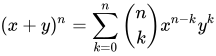
So the x and y terms descend and ascend in the correct order?
For example:
Let n = 3
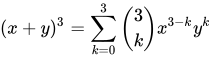





Let x = 2 and y = 4



— Preceding unsigned comment added by 74.134.125.183 (talk) 01:57, 5 December 2006 (UTC)
- They're both the same
- It's not hard to see why
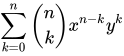
- must be exactly the same thing as
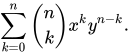
- Just try it, the way you do with your examples above. Michael Hardy 03:06, 5 December 2006 (UTC)
- They're the same but...
- It should be written
- since that is standard notation.
- also some of the examples and the proof start with the x term first while newton's generalization start with the y term.
- they should at least be written in one standard way.
- Heycheckitoutyo 04:11, 29 January 2007 (UTC)
- It should be written
- Why is that any more standard than the other way? Both are equally correct; you'll find both forms, depending on the specific textbook you're using. —Lowellian (reply) 03:02, 27 May 2007 (UTC)
- --> I agree, revert back to the way it was, since, well it was that way first. x^k * y^(n-k)
- --JRK, unregistered —Preceding unsigned comment added by 192.197.54.136 (talk) 18:28, 6 November 2007 (UTC)
k is not specified
What is k? —Preceding unsigned comment added by 84.203.7.90 (talk) 10:58, 15 May 2008 (UTC)
A quick way to expand binomials
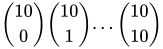
Wouldn't it be clearer to note that the coefficients of the expansion can also be written:
—Preceding unsigned comment added by Lextrounce (talk • contribs) 05:05, 9 October 2008 (UTC)
Proof
Clarification needed
y multiplying through by a and b

Could someone clarify how a and b are multiplied thru? Remember, it's not just mathematically mature readers this encyclopedia is for; otherwise you'd be preaching to the choir. Specifically, how is the result a^(m+1) extracted from the prior line on the chain. BeyondBeyond (talk) 19:31, 27 July 2008 (UTC)
- Question,
- In the 4th statement of the proof I'm not sure I understand why you would multiply through by a and b. It seems all you do is pull out the first term in the first summation. —Preceding unsigned comment added by 128.180.4.137 (talk) 03:35, 8 February 2009 (UTC)
May 7 edits
I would suggest reverting all the edits made on May 7, 2009. The equivalence of the two equations requires no properties of (n choose k). Instead, just substitute x for y, and y for x. My feeling is that this is not worth mentioning in the introduction to the article. Also, it is important to state the conditions on x and y at the very beginning. --FactSpewer (talk) 04:01, 12 May 2009 (UTC)
Binomial number
The section on Binomial Number has nothing to do with the binomial theorem. I suggest removing it (I think it is not a commonly used expression and "binomial number" is more often used to refer to binomial coefficients). Alternatively, it could be moved to its own article, but I am not sure it deserves an article of its own. --FactSpewer (talk) 04:06, 29 May 2009 (UTC)
The binomial theorem in popular culture
"Just..no" is not sufficient justification for removing a section to which about a dozen distinct authors have contributed. Instead one should begin by discussing it on the Talk page. I am not among the contributors, but my personal feeling is that this section is comparable to sections that appear on several other pages, outlining the connection of scientific topics with popular culture, so I advocate keeping it. WardenWalk (talk) 16:46, 30 May 2009 (UTC)
- I think the binomial theorem, perhaps because the name is easy to remember, is used as specific example of stuff one was forced to learn in school that has no use in everyday life (this is certainly the point in the Major-General song and the Monty Python skits). It's notable because the same fame has not attached to many other theorems that every mathematician is familiar with (perhaps contrast to the Mean value theorem or the central limit theorem). I think this would help explain why this section is useful here, while is not in many other articles, but as far as I know this is original research on my part, and so not suitable for addition. Instead we can list the actual uses and let the reader decide... LouScheffer (talk) 18:26, 30 May 2009 (UTC)
Cleanup finished?
I think that the article is now in sufficiently good shape that the "clean up" banner can now be removed. If you agree, please remove it. Ebony Jackson (talk) 04:39, 4 July 2009 (UTC)
Is this correct?
In the article, in the generalized binomial theorem section, it defines the generalized binomial coefficients by:

- In case k = 0, this is a product of no numbers at all and therefore equal to 1, and in case k = 1 it is equal to r, as the additional factors (r − 1), etc., do not appear.
- Another way to express this quantity is
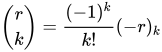
Is the last line correct? (-r)k denotes a falling power, so it seems like it should be
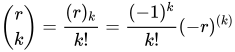
Perhaps this is just a matter of the notation the original author was using was (r)k to denote a rising power, but it disagrees with the linked page so should probably be consistent. 75.33.224.226 08:29, 13 October 2007 (UTC)
Falling factorial notation
I suggest switching to Knuth's falling factorial notation — unlike the Pochhammer symbol, it's not overloaded with two contradicting definitions. 213.21.117.168 (talk) 00:10, 9 November 2009 (UTC)

- I've corrected the text, someone went and stuck in a minus sign recently. It should have been just (r)k with no minus sign. The OP is confused by minus signs as well, there should be no −1 or-−r in the expression. Dmcq (talk) 09:13, 9 November 2009 (UTC)
- That nicely demonstrates that the Pochhammer notation is confusing. Making the change. 130.239.119.186 (talk) 14:16, 9 November 2009 (UTC)
- The Knuth notation is not widespread, the Pochammer is. And in my opinion putting an underline on a superscript is far more confusing. If the person had read the Pochammer page properly they wouldn't have made this mistake. I'll be changing it back. Dmcq (talk) 14:53, 9 November 2009 (UTC)
Proof of convergence of (1+ 1/n)^n to 1+1/1!+1/2!+1/3! ... in the main article is wrong
The proof refers to the monotone convergence theorem, where the subject of its application doesn't satisfy the theorem's conditions. If we speak of convergence of an infinite row of real numbers, each term of the row shouldn't change with the increase of the number of terms, when we approach infinity. This is wrong for the expanded representation of (1+1/n)^n: as a single member of the row depends on n and changes as we make the n greater. In other words, (1+1/n)^n is obviously not a row of real numbers.

Now, if the proof implies, that the sequence of converges to 1\k! with increasing n and refers to this in terms of application of the theorem, this is ok. But still, it doesn't prove that the whole sum (1+1/n)^n approaches 1+1/1!+1/2!+1/3!..., because the number of terms in the expansion is infinite and a sum of infinte number of limits is not the same as the limit of the sum.
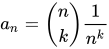
Thus the proof is incomplete and the phraze of the fair copy
"This indicates that e can be written as a series:"
":"

is groundless.
P.S. I'm sorry for being non-constructive, and damaging the fair copy of this page with this remark yesterday; I've just got very tired of endless math analysis books with such hacks in fundamental places like this. Why do mathematitians repeatedly make such mistakes in their proofs and noone cares?
—Preceding unsigned comment added by 91.78.94.55 (talk) 14:43, 3 March 2010 (UTC)
- Actually mathematicians usually do care a lot about steps of a proof following the proper rules. In this case the monotone convergence theorem#Convergence of a monotone series does give the required justification for this result. It states that if you have an infinite matrix of non-negative real numbers such that
- the columns are weakly increasing and bounded, and
- for each row, the series whose terms are given by this row has a convergent sum,
- then the limit of the sums of the rows is equal to the sum of the series whose term k is given by the limit of column k (which is also its supremum); in particular the latter series has a convergent sum if and only if the (weakly increasing) sequence of row sums is bounded and therefore convergent. Here the matrix entry in row n and column k is
- the columns (fixed k) are indeed weakly increasing with n (takes a bit of thought but the displayed forms facilitates this) and bounded (by 1/k!), while the rows only have finitely many nonzero terms, so condition 2 is OK; the theorem now says that you can compute the limit of the row sums by taking the sum of the column limits, namely . Marc van Leeuwen (talk) 16:23, 3 March 2010 (UTC)



Thanks a lot for a detailed and intelligible explanation of the formulation! As far as I understand, the condition 2 requires that
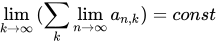
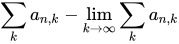
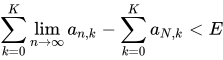
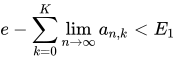
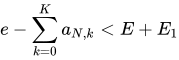
My main concern about the possible vulnerabilities of the formulation was the fact, that the column limits' increase is not orchestrated, and thus for an arbitrary large n the sum of terms in the n-th row might have differed from the limit value by a non-zero constant. (in other words, if you want to create a counterexample, you need to be a non-zero constant for any arbitrary large n. To keep that, increase the first term of the n+1 row only by the value of the new emerging k+1 term, so that the overall sum would stay the same). Actually, the condition 2 rules out this possibility, cause the limitting series remainder is 0. For any , you can pick the first K terms of the limitting series (1+1+1/2!+... in this case), and pick N, so that the . As the limitting series converges, the sum of first K terms can be arbitrary close to e (), depending on K choice, so . I guess, this should be the essense of the theorem's proof. Thank you, once again. —Preceding unsigned comment added by 91.78.94.78 (talk) 02:09, 5 March 2010 (UTC)

Misleading convergence conditions in Newton's generalized binomial theorem
- To me, saying that x and y are "close together" is quite different from saying that |y|/|x|<1. Consider x = 100 and y = 100.0001, for instance.
- If one writes the condition as |y|<|x|, then one does not need to mention that x is nonzero. (This is also simpler than writing |y|/|x|<1.)
- Most importantly, I feel that for mathematical correctness, the hypotheses needed for (2) to have a meaning should be given right at the beginning of the section, instead of 10 lines later. Or at least the first sentence should say something like "under conditions to be explained later".
- If one wants to allow x and y to be complex in (2), one needs to be very careful about choosing an appropriate branch of log to avoid getting a false statement. For example, if one uses the principal branch of log, then the statement will be wrong for x = -2+i and y = -2i. One solution is to use a holomorphic branch of log defined on the open disk of radius |x| centered at x.
- On the other hand, many readers will be most interested in the real case, and it would be unfriendly towards novices to leap into a discussion about branches of the complex logarithm. So I would suggest first stating the result for the case where x and y are real and satisfy |y|<x. Then much later on, one could mention how to extend it to complex numbers.
I would be happy to make an edit along these lines if no one objects. --FactSpewer (talk) 02:08, 15 October 2008 (UTC)
- Wouldn't the branch cut of the log need to be analytic in some neighborhood of y as well? —Preceding unsigned comment added by 209.147.101.240 (talk) 23:14, 23 April 2011 (UTC)
In finite fields
It is well known that in Z/pZ, C(p,k)=0 for 0<k<p, and that therefore (x+y)^p = x^p + y^p. I think this should be mentioned here or in Newton's binomial theorem. — MFH:Talk 04:35, 25 August 2014 (UTC)
- This is a direct consequence of the fact that raising to the pth power is a field automorphism of Z/pZ. In fact, the statement generalizes to any finite field Fq where you will have (x+y)q = xq + yq. It is questionable whether or not this should be mentioned here, as it is not really a property of the binomial theorem, but more of the underlying field. I see no connection with Newton's binomial theorem. There is a connection with Pascal's triangle when the entries are reduced mod p for some prime p. Bill Cherowitzo (talk) 04:57, 25 August 2014 (UTC)
- "This [(x+y)^p = x^p + y^p] is a direct consequence of the fact that raising to the pth power is a field automorphism of Z/pZ." I don't know much about finite fields, but isn't it the reverse? It's a field automorphism because (x+y)^p = x^p + y^p? I'm not sure why Newton's binomial theorem (rather than the original version) is relevant though. Quietbritishjim (talk) 14:47, 25 August 2014 (UTC)
- I phrased it that way because the condition, by itself, doesn't make it a field automorphism (the function also needs to be a bijection and multiplicative as well). The issue of what is a consequence of what depends pretty much on what you take as a definition versus what you consider as a property. I am using the definition that a field automorphism is a bijection which preserves the field operations. The condition we've been talking about is then an immediate consequence of this definition. Of course, if you were trying to prove that the Frobenius map is a field automorphism you would (among other things) have to establish the validity of this condition first. I think that it is slightly more encyclopedic to just state well known results rather than present them, as a textbook should, in a way that indicates how they might be proved. Bill Cherowitzo (talk) 16:14, 25 August 2014 (UTC)
Suggested summation for 00 undefined
| Discussion should take place here. |
|---|
| The following discussion has been closed. Please do not modify it. |
|
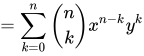
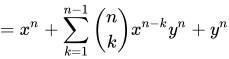
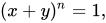
For , the latter representaton has the advantage of not having to define For and for we have also without having to define Some indication of the controversy over the definition of can be found at Exponentiation under the heading "History of differing points of view." --Danchristensen (talk) 04:58, 12 May 2015 (UTC)
|




Please clarify statement in opening paragraph
"When an exponent is zero, the corresponding power expression is usually omitted from the term." I was thoroughly confused by the intended meaning of this. Does it simply mean that any x or y raised to the power 0 is taken to be 1? If so, why not say exactly that? Otherwise, it's unclear what exponent is being referred to, what power expression is being referred to, and what is meant by "associated" power expression. If that is *not* what is meant, then I would request that the statement be rewritten to clarify the intended meaning. Craniator (talk) 17:36, 14 June 2015 (UTC)
- Bill Cherowitzo's version was much better than the previous one, but I think consideration of weight dictates that we should just ignore this issue in the lead paragraph. It's a minor technical detail, and it was receiving more prominence than binomial coefficients. We can address it in the body, instead. --JBL (talk) 15:37, 18 June 2015 (UTC)
- Good point. Should have thought of doing that myself. Thanks. Bill Cherowitzo (talk) 17:06, 18 June 2015 (UTC)
Reference the "Binomial series" and remove examples when n is not a positive integer.
I suggest that following the first sentence: "In elementary algebra, the binomial theorem (or binomial expansion) describes the algebraic expansion of powers of a binomial." that a sentence is added stating "For binomial expansions where the exponent is not a positive integer, see the article regarding the Binomial series."
Then, I suggest that the examples (pasted below) regarding square roots (n=1/2) and negative exponents (n=-1) be removed, because they are clearly out of scope of this article.
"Another useful example is that of the expansion of the following square roots:


Sometimes it may be useful to expand negative exponents when :

- "

See [1] from http://www.haverford.edu/physics/MathAppendices/Binomial_Expansions.pdf, which apparently are public domain and in my opinion has a better "Statement of the theorem" than this article. For example, it also states that "The series in eq. (1) can be used for any value of n, integer or not, but when n is an integer the series terminates or ends after n+1 terms." 207.107.66.194 (talk) 15:00, 6 July 2015 (UTC)
- I agree with both proposed edits (removal of out of scope examples and addition of a sentence pointing to the binomial series, possibly to the lead of the article where it can easily be located). Sławomir Biały (talk) 17:38, 6 July 2015 (UTC)
References
- ^ Notes on Binomial Expansions and Approximations
External links modified
Hello fellow Wikipedians,
I have just added archive links to one external link on Binomial theorem. Please take a moment to review my edit. If necessary, add {{cbignore}} after the link to keep me from modifying it. Alternatively, you can add {{nobots|deny=InternetArchiveBot}} to keep me off the page altogether. I made the following changes:
- Added archive https://web.archive.org/20150224130932/http://proofs.wiki:80/Binomial_theorem to http://proofs.wiki/Binomial_theorem
When you have finished reviewing my changes, please set the checked parameter below to true to let others know.
 An editor has reviewed this edit and fixed any errors that were found.
- If you have discovered URLs which were erroneously considered dead by the bot, you can report them with this tool.
- If you found an error with any archives or the URLs themselves, you can fix them with this tool. manual cross check, ready to fly, although can a bot really claim to be a fellow Wikipedian..... Asimov would likely say yes, so hand shake the robot FeatherPluma (talk) 05:08, 5 June 2016 (UTC)
Cheers. —cyberbot IITalk to my owner:Online 20:56, 15 October 2015 (UTC)
Examples
In the examples section there are some with fractional or negative exponent, but the generalized binomial theorem that deals with those cases is only mentioned later. Up to this point only non-negative integer values of $n$ have been considered and the summation is always from 0 to . — Preceding unsigned comment added by Pacosantosleal (talk • contribs) 12:24, 25 November 2015 (UTC)

Meaning of n choose k
- mean nk ? — Preceding unsigned comment added by Skk146 (talk • contribs) 15:49, 27 November 2016 (UTC)
- No it doesnt 2001:448A:6090:17DF:3129:CE3:3DED:E205 (talk) 09:00, 9 August 2025 (UTC)

History
Joel B. Lewis I think it's better to cite Rashed here, because the source used is St Andrews, but while O'Connor and Robertson quote Rashed's statement, and apparently agree with it, the statement itself is Rashed's alone, and would be best cited directly to the source where he makes it. Not doing so when the source is readily available online is very poor scholarly practice. Best regards.---Wikaviani (talk) 00:37, 5 May 2018 (UTC)
recent edits
To help settle this recent conflict, I'm starting this talk page section. To the IP who keeps edit warring their preferred version in, there are a lot of inappropriate spacing changes you're making, as well as things like changing the capitalization of piped links (the link part, not the visible part); this should not be done. There are also a lot of invisible wikicode changes you're making. These are fine in and of themselves, but edits should not be made just to do that. See WP:COSMETICBOT for further info about these. WP:BRD is a pretty good idea. If someone reverts your changes from the status quo, it's really up to you to try to justify the changes, not make snarky retorts that don't address the disagreement. So again, please discuss here rather than trying to re-add. –Deacon Vorbis (carbon • videos) 21:05, 28 April 2019 (UTC)
- The only reply to your only point, which is to assert "inappropriate", is to assert "appropriate". I am not going to further engage in pointless rhetoric with people want to claim that some standard should be met, never stating that standard, and moving it when it pleases them.80.65.247.112 (talk) 22:57, 28 April 2019 (UTC)
- If you're unwilling to discuss, then you have no basis to continue to insist on your changes. If there's objection to those changes, you need to pause and resolve that objection rather than just plowing ahead. I've made some specific points here which should be addressed. Since you're unhappy with my use of "inappropriate", I'll elaborate on the spacing. You're using little-used manual spacing templates that aren't well known, aren't needed, produce inconsistent results, run contrary to MOS:MATH, and thus make maintenance more difficult. You've also added delimiter sizing commands that aren't needed – like vs. This produces no difference in rendered output. A small handful of the changes you made were reasonable, mainly display mode vs. text mode for binomial coefficients. I reinstated those (which you took back out in your rush to revert me), but the vast majority were either unnecessary or actively harmful. I don't know why you feel such a need to see these edits stand, but there are good reasons why they shouldn't. –Deacon Vorbis (carbon • videos) 23:18, 28 April 2019 (UTC)
- I notice that 80.65.247.112 doesn't want to say much on this Talk page, and doesn't leave edit summaries to give some hint as to his motivation. Neither of these habits is compatible with the way we do things on Wikipedia. Conversely, Deacon Vorbis not only shows a willingness to use the Talk page constructively, he shows an enthusiasm for doing so. Therefore I endorse the standard advocated by Deacon Vorbis. The editor at 80.65.247.112 should either adopt the Wikipedia way of doing things, or get used to the idea that all his hard work will one day amount to nothing. It should be an easy decision. Dolphin (t) 13:16, 29 April 2019 (UTC)
- If you're unwilling to discuss, then you have no basis to continue to insist on your changes. If there's objection to those changes, you need to pause and resolve that objection rather than just plowing ahead. I've made some specific points here which should be addressed. Since you're unhappy with my use of "inappropriate", I'll elaborate on the spacing. You're using little-used manual spacing templates that aren't well known, aren't needed, produce inconsistent results, run contrary to MOS:MATH, and thus make maintenance more difficult. You've also added delimiter sizing commands that aren't needed – like vs. This produces no difference in rendered output. A small handful of the changes you made were reasonable, mainly display mode vs. text mode for binomial coefficients. I reinstated those (which you took back out in your rush to revert me), but the vast majority were either unnecessary or actively harmful. I don't know why you feel such a need to see these edits stand, but there are good reasons why they shouldn't. –Deacon Vorbis (carbon • videos) 23:18, 28 April 2019 (UTC)

