


User talk:Malparti
You can contact me by leaving messages on that page (to do that, click on "New section").
Generation Time Talk Page Response
[edit]Hi Malparti, I replied to your response on the talk page of the Generation time article. I agree with all your points and I made a suggestion to possibly improve the article. Cheers, TROPtastic (talk) 02:03, 8 August 2017 (UTC)
Don't do that again
[edit]Hi Astro-Tom-ical,
I've just come across this edit where you added non-breaking spaces everywhere in the LaTeX formulas. That makes the code harder to read (and, therefore, harder to maintain) and messes up the spacing. Please avoid doing this in the future. I am reverting the problematic parts of this specific edit, please consider doing the same thing for other similar edits you might have made.
Regarding your destructive edits, thank you for warning me. I say that it was plain vandalism and have undone your reversion.
It seems to be disingenuous of you to sign off with "Best" after a malicious reversion, while also leaving a specious admonition that I should vandalize my own edits.
Inspection of your contributions shows that you are interested in statistics. In that case you should already be aware of how mathematical formulas and running text are separated with blank space: Every formula or symbol embedded in text should be separated from prose with small, but noticeable extra blank space. This includes English-language punctuation, such as periods, which indicate an end to a prose sentence which includes a formula at its finish. Likewise commas and semicolons. In statistics this is particularly important, since statistical notation includes subscripted dots, resembling periods, that indicate the sum over a subscript, e.g.
- where
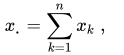
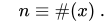
Also, all language punctuation must be imbedded (with space) at the end the LaTex of any formula it follows, in order to ensure that a line break will not split the punctuation onto the following line.
Further, mathematics is font specific, so that are all distinct symbols. That means that simply adding italics to the character k embedded in prose text produces the symbol k , which is rendered in the sans-serif font and hence the wrong symbol. The correct symbol is k which appears in the formula (above). That is a error that you re-introduced. Don't do that.

It is common for people typesetting mathematics for papers to be unaware of these rules, since journals which can afford to edit articles to conform with house rules, concerning headers, footers, format of equation numbers, and reference numbers. (Publications of course try to enforce their house style on prospective authors, to whatever extent they can, but there is always typesetting, such as placement on the printed journal's pages, that an author cannot do.)
Also, I dismiss your complaint that the <math>\ at the beginning of a formula and \ ,</math> at its end makes it hard to read. You should be ashamed for making up such spurious excuses for your own bad editing.
So no, I will not change to editing math to please your reading of LaTex code. I will be redacting LaTex code to make the Wikipedia math articles look more like how math is typeset in professionally produced, math-savvy publications. The little bit of space added is part of communicating the meaning in LaTex, and something the default rendering does not do, and which Knuth specifically did not design into LaTex: It's up to the mathematician to put the meaningful spacing in; the rendering engine cannot and should not decide whether a final comma is a pause in speaking, or a tensor notation for a derivative on the final symbol. Astro-Tom-ical (talk) 11:44, 15 December 2022 (UTC)
- → My reply to this comment can be found on Astro-Tom-ical's talk page, assuming they have not deleted it (as was the case with my original comment). Malparti (talk) 13:25, 16 December 2022 (UTC)
ArbCom 2023 Elections voter message
[edit]
Hello! Voting in the 2023 Arbitration Committee elections is now open until 23:59 (UTC) on Monday, 11 December 2023. All eligible users are allowed to vote. Users with alternate accounts may only vote once.
The Arbitration Committee is the panel of editors responsible for conducting the Wikipedia arbitration process. It has the authority to impose binding solutions to disputes between editors, primarily for serious conduct disputes the community has been unable to resolve. This includes the authority to impose site bans, topic bans, editing restrictions, and other measures needed to maintain our editing environment. The arbitration policy describes the Committee's roles and responsibilities in greater detail.
If you wish to participate in the 2023 election, please review the candidates and submit your choices on the voting page. If you no longer wish to receive these messages, you may add {{NoACEMM}} to your user talk page. MediaWiki message delivery (talk) 00:43, 28 November 2023 (UTC)
Revert in Functions (Mathematics)
[edit]There is a discussion in the talk page of that article already. It is explained there exactly what the edit accomplishes. Could you please revert your revert of the revert, until consensus is achieved in the talk page? The edit keeps close to both the previous version, and to primary sources like Halmos' Naive Set Theory and Apostol's Analysis. Thatwhichislearnt (talk) 14:00, 14 March 2024 (UTC) Specifically, in this section of the talk page Thatwhichislearnt (talk) 14:02, 14 March 2024 (UTC) Would you care to participate in the discussion, before arbitrarily reverting? Is there a mathematical concern that you think is fixed by the revert? There is one, in the version that you reverted to, though. The previous user reverted also without addressing it, and raised a concern that their previous version would also have, if the concern were founded. Thatwhichislearnt (talk) 14:07, 14 March 2024 (UTC)
- → My reply can be found on the talk page of the article. Malparti (talk) 15:06, 14 March 2024 (UTC)
Markov Chain URL removed
[edit]Hi -- I appreciate your attention to detail, however, I disagree with the removal of this link. First, it seems that other links in that list are in the same boat -- written by individuals and posted there, and they are not nearly as in-depth or complete as what I posted, here are examples from this Wiki article:
https://setosa.io/blog/2014/07/26/markov-chains/index.html "A visual explanation by Victor Powell"
https://web.archive.org/web/20200204031008/http://rarlindseysmash.com/posts/2009-11-21-making-sense-and-nonsense-of-markov-chains by "Lindsay Beida"
https://jasss.soc.surrey.ac.uk/12/1/6.html (multiple names, this one is more in-depth, but very poorly organized).
Also, the youtube link at the top is clearly 'promotion' too, by your definition. Whatever standards are being applied here, they not being applied consistently. Second, the content of the other external links is not nearly as well organized or as pedagogical -- I encourage you to see for yourself, just click through a few of them, and then look at what I posted.
I think the link adds to the article in a meaningful and applied way, well beyond what is contained in any of the external links and in the article itself (though of course, the article has other goals and covers more breadth). It is intended, for those looking to go a level deeper and more applied/technical.
Also, honest question: What does "promotion" mean here? I'm not making a single penny for doing this, the tutorial only has value as an element of education, and I don't have a channel / stream / insta I'm pushing, nothing. It's just to help people learn, so it's disappointing to have sincere, good, clear effort on a complex topic removed for inconsistent reasons.
Tristansu (talk) 22:43, 4 June 2024 (UTC)
- Hi @Tristansu,
- I agree with what you say about most of the other links, I think many of them should be removed from the article. The reason why I removed the specific link that you added is because I happen to have seen your edit in my watch list — not because this link needed to go whereas the others deserved to stay.
- (reply: Ok, and I see some have now been removed.) Tristansu (talk) 00:22, 4 June 2024 (UTC)
- Concerning the link that you added: I do not want to discuss the merits of the document itself, because this is somewhat irrelevant. However:
- Dropbox links are not ideal for Wikipedia, because they are non-permanent (not to mention that they tend to look a bit fishy).
- (reply: That was fixed btw in the last edit.) Tristansu (talk) 00:22, 4 June 2024 (UTC)
- Markov chains on a finite state space are a pretty basic topic, and as a results there are tons and tons of excellent textbooks / lecture notes available on the topic at about every level — so I could not see what this specific document adds to article.
- (reply: isn't the point of the 'external links' to provide links to such content (e.g. what I posted), which are sorely missing from this article?) Tristansu (talk) 00:22, 4 June 2024 (UTC)
- Regarding my use of the word "promotion", it was probably a bit excessive. My point was that, while linking to documents that you have written can be perfectly OK under certain circumstances (if there is no conflict of interest), in general this is frowned upon. So, unless the documents really adds something that was missing from the article and there is no easy to find alternative online, as a rule of thumb it is probably better to avoid linking to documents that you have written yourself.
- (reply: re promotion: all external content is written by someone (ignoring current AI), and it is appropriate and professional, not to mention incurs a level of personal responsibility to the work, to put one's name on it, as is the case for all of the external links in this article. I still disagree, but do as you wish. While no hard feelings, this has been a disenfranchising discussion, that certainly reduces the likelihood that will contribute to Wikipedia in the future.) Tristansu (talk) 00:22, 4 June 2024 (UTC)
- Hope that clarifies things and that there are no hard feelings.
- Best, Malparti (talk) 23:36, 3 June 2024 (UTC)
- PS: don't forget to sign your messages with
~~~~
ArbCom 2024 Elections voter message
[edit]Hello! Voting in the 2024 Arbitration Committee elections is now open until 23:59 (UTC) on Monday, 2 December 2024. All eligible users are allowed to vote. Users with alternate accounts may only vote once.
The Arbitration Committee is the panel of editors responsible for conducting the Wikipedia arbitration process. It has the authority to impose binding solutions to disputes between editors, primarily for serious conduct disputes the community has been unable to resolve. This includes the authority to impose site bans, topic bans, editing restrictions, and other measures needed to maintain our editing environment. The arbitration policy describes the Committee's roles and responsibilities in greater detail.
If you wish to participate in the 2024 election, please review the candidates and submit your choices on the voting page. If you no longer wish to receive these messages, you may add {{NoACEMM}} to your user talk page. MediaWiki message delivery (talk) 00:28, 19 November 2024 (UTC)
Polya's urn description
[edit]Hello,
It is nearly impossible to understand why my clearer sentence was reverted to previous, non-crisp version. What do you exactly mean by "the previous was clearer"? Thanks. s-guy (talk) 08:57, 16 December 2024 (UTC)
- Hi @Snehalshekatkar,
- First off, thanks for reaching out; I hope you didn't take my revert personally.
- What I meant by "the previous was clearer" was that I thought that the sentence:
- If by random chance, more black balls are drawn than white balls in the initial few draws, it would make it more likely for more black balls to be drawn later.
- is easier to parse than:
- If by random chance, more balls of one of the two colors are drawn than that of the other color in the initial few draws, it would make it more likely for more balls of that color to be drawn later.
- In particular, in addition to being a bit clunkier, the second version has the problem that the grammatical interpretation is tied to the semantics: to understand what "that one" refers to in the construction "one of the two ... the other one ... that one", it really helps to understand what the sentence means. In particular, some people — I'm mainly thinking about non-native speakers — could be tempted to think that "that one" refers to the last thing that was mentioned. If you want to explain to them why this is not the case, you'll have to: either explain why this does not make sense; or resort to some advanced English (e.g, "if that were the case, we would have said it this way"). So it is better to make things as simple as possible by avoiding any potential source of confusion.
- Second, in my point of view you are trying to cram too much in one sentence dealing with the argument and the symmetry between black and white at the same time. In my experience (yours might be different), when explaining something basic, it is better to separate things as much as possible: start with something concrete, than people can instantly picture (i.e. "a black ball", not "a ball of one color; could be black or white, but if you picture it black picture the other one white, and vice-versa"). And then point out that there is a symmetry (anyone who understood the first part should immediately understand that).
- Hope that clarifies why I reverted your edit.
- Best, Malparti (talk) 18:34, 16 December 2024 (UTC)
Notice of noticeboard discussion
[edit] There is currently a discussion at Wikipedia:Administrators' noticeboard regarding an issue with which you may have been involved. The discussion is about the topic Improper removal of Wiley academic source from "Markov chain" article — possible coordinated abuse. ~~~~ EricoLivingstone (talk) 11:13, 31 March 2025 (UTC)
- → User:EricoLivingstone has been blocked indefinitely. Malparti (talk) 12:31, 2 April 2025 (UTC)
Markov Chains and Cryptography – Your Thoughts?
[edit]Hi,
I’ve been browsing through Wikipedia lately and stumbled across your talk page specifically, that interesting exchange about Markov chains and their applications in statistical modeling. I’m a grad student at UC Irvine, working on a thesis about how foundational concepts like Markov chains have influenced modern cryptographic systems. I was researching for my thesis, and then I stumbled upon some work by Professor Amit Sahai at UCLA that I thought you might find interesting. He’s been exploring how probabilistic models, including Markov chains, can be applied to secure computation protocols. There’s a research note on his site that dives deeper into this, and I figured it might spark some ideas for your future contributions.
If you’re interested, you can check it out here: https://web-cs-ucla-edu.org/. I’d love to hear what you think if you get a chance to peek at it, your perspective on cryptography history could really help me sharpen my own work. Thanks for your time, and keep up the awesome contributions on Wikipedia! Tudorx95 (talk) 09:22, 26 April 2025 (UTC)
Your thread has been archived
[edit]
|
Hello Malparti! The thread you created at the Teahouse, You can still read the archived discussion. If you have follow-up questions, please .
See also the help page about the archival process.
The archival was done by lowercase sigmabot III, and this notification was delivered by KiranBOT, both automated accounts. You can opt out of future notifications by placing |
ArbCom 2025 Elections voter message
[edit]Hello! Voting in the 2025 Arbitration Committee elections is now open until 23:59 (UTC) on Monday, 1 December 2025. All eligible users are allowed to vote. Users with alternate accounts may only vote once.
The Arbitration Committee is the panel of editors responsible for conducting the Wikipedia arbitration process. It has the authority to impose binding solutions to disputes between editors, primarily for serious conduct disputes the community has been unable to resolve. This includes the authority to impose site bans, topic bans, editing restrictions, and other measures needed to maintain our editing environment. The arbitration policy describes the Committee's roles and responsibilities in greater detail.
If you wish to participate in the 2025 election, please review the candidates and submit your choices on the voting page. If you no longer wish to receive these messages, you may add {{NoACEMM}} to your user talk page. MediaWiki message delivery (talk) 00:38, 18 November 2025 (UTC)
you reverted my edit on the Central Limit Theorem page
[edit]here's the problem with your reversion and what was right about my edit: I looked at the cited source and whoever added the material to wikipedia originally changed the sense of it and broke it. I was fixing it in keeping with the meaning of the cited source. You suggest deleting the figure: then delete it; that figure comes from the cited source and the text accompanies it. I don't know if you looked at it and don't understand it, or if you are just applying a lazy reversion. ~2025-32100-27 (talk) 02:29, 23 November 2025 (UTC)
- Hi @~2025-32100-27,
- First, a quick remark: I had not read the source in question before reverting your edit. I've done it now, and that made me realize that this source is not very good. I'll try to find the time to replace it by a better one.
- Now: in the source in question, everything is stated in terms of "sampling distribution" — see e.g. p.10. Unfortunately, the book doesn't introduce this quantity formally (and the notation is a bit confusing); but it refers to the distribution of , the sample mean (I am using the notation of the book; a better notation would be , to emphasize the fact that this is a random variable and that it depends on n). Of course, that's not the standard way to state the central limit theorem, and to get a proper convergence one should instead focus on the distribution of the rescaled sample mean, that is,
- but the source is what it is, and so is the current article... So let's work with what we have and interpret "tends to" as "becomes close to" rather than as a precise mathematical notion.
- With that in mind: the figure and its caption "correctly" state that the sampling distribution "becomes close to" as n goes to infinity. I don't see how talking about the "the distribution of repeated samplings" instead of the "sampling distribution" clarified anything. Hence the fact that I reverted your edit.
- Best, Malparti (talk) 13:30, 23 November 2025 (UTC)


the different "english language variants" of the word sample (sample, samples, and sampling) are ambiguous. You can throw 10 darts at the the population distribution on the left, and that could be your sample; or you could thrown one dart at the population distribution and call that your sample. Back to 10 darts, you could declare that your sample size will be 10, and you could do it 10 times, which would be 10 samples, not 100 samples. The word sampling is not at all specific as to what your sample size is. The text accompanying the graphic: "the sampling distribution tends to a Gaussian" does not make sense if you make one sample; it also does not tend to a Gaussian if you take 10 samples: each one of them will have the distribution of the original population. It's only if you compute a mean of a 10 dart sample, and repeat that process that you get something that "tends to" something other than the population distribution. And it turns out that what that will tend to is the Gaussian no matter the shape of the population density, and that is the stunning fact people reading this article need to learn. I think the original text in the article, which is not the text in the source, is misleading for people who need to learn this. ~2025-32100-27 (talk) 06:40, 25 November 2025 (UTC)
- Just to make sure we're on the same page on the math, and to give precise names to quantities to make the discussion easier: let be the distribution of and be that of .
- The central limit theorem is that tends to as goes to infinity.
- From this, we get . Unfortunately, this isn't very helpful because "" isn't a precise mathematical notion.
- In the source you were quoting, everything is stated in terms of the sampling distribution. Unfortunately, this quantity is not defined formally in the source; however we can infer that it refers to and that their "central limit theorem" is point 2 above. This is a problem, and it should be fixed.
- As far as I can tell, the source is quoted "correctly". Yet you stated that "whoever added the material to wikipedia originally changed the sense of it and broke it". Please be more specific: how are things phrased in the source and what was changed when quoting it here?
- In your edit, you changed "sampling distribution" to "distribution of repeated samplings". I reverted that because I think that the latter is confusing: there is no need for "repeated samplings" in the CLT: take one sample; that gives you a distribution ; when the size of the sample goes to infinity, this distribution converges to a Gaussian. Maybe that makes it easier for you to think about it as an iterative process, but that's not necessarily going to be the case for every one.
- Now, having said that: I agree that the figure and its caption are not very good because (1) it's very clear what the "sampling distribution" refers to (I would prefer something like "the distribution of the sample average"); (2) the "as the size of the sample goes to infinity" is missing and (3) again, what is depicted in the figure isn't the central limit theorem; it's ...
- Malparti (talk) 11:35, 25 November 2025 (UTC)


Uniform integrability
[edit]Please stop reverting changes that allude to "equi-integrability" as it muddles the waters in my opinion.
- A family is equi-integrability, as defined by the Fonseca et. al., of for any $\varepsilon>0$ there is $\delta>0$ such that

This is not equivalent to Definition A in the Wikipedia article uniform integrability for it is missing the uniform boundedness condition .


- Definition A became common in advance Probability theory textbooks (written in different languages) after the work by Hunt. The original paper of Hunt (in French), although written in the area of Probability, deals with the general notion as described in Definition H of the Wikipedia article.
- Dunford and Pettis (1939-1940) r result on compactness in the weak topology <\math>\sigma(L_1,L_\infty)</math>) (see the celebrated book Dunford & Schwartz, Part 1, 1957) predates the paper of Hunt (1966) that introduces uniform integrability. Dunford and Pettis result show that a family is weak compact if and only if it satisfies conditions which in the parlance of modern times are: equi-integrability (as in Fonseca idem.), uniform boundedness and tightness. Tightness means that for any , there is a set with such that . and a is indeed uniformly integrable (in the sense of Hunt) and viceversa.
- Then, equi-integrability, along with uniform boundedness in and tightness is equivalent to uniform integrability as in Hunt.
- It is rather unfortunate that the author (Fitzpatrick) who took over after Royden's passing, use the name uniform integrability for what it is known as equi-integrability (as in Fonseca). With some work (along the lines of the Vitali convergence theorem) it is an exercise to show that equi-integrability, tightness and boundedness is equivalent to Hunt's uniform integrability


Indydiaz (talk) 23:28, 1 December 2025 (UTC)
- Hi @Indydiaz,
- First, as I mentioned on your talk page, I think the best way to discuss this is on the Article talk page. That makes it easier for other people that might have relevant things to say to become aware of the discussion and join it.
- Second, a quick reply to some of your points:
- You are correct that the condition is missing from the Fonseca et al definition of equi-integrability, and that this does make a difference; and I did find the same distinction between equi- vs uniform integrability in other sources.
- You might be correct that using equi-integrability and uniform integrability interchangeably "muddies the waters" and that "it is unfortunate that [Fitzpatrick] uses the name uniform integrability for what it is known as equi-integrability". However, the goal of Wikipedia is to summarize the way that reliable sources use terms, not the way they should be used; and, as it stands, some reliable sources do not make a distinction between equi-integrability and uniform integrability (in addition to Royden/Fitzpatrick, see for instance Heinz Bauer's remark that Equi-integrable sets and families are sometimes also called "uniformly integrable" in Measure and Integration Theory).
- As a result of the previous point, unless it can be established that the fraction of reliable sources that do not make a clear distinction between uniform integrability is negligible, the article can't just present the "most logical" or "most historically accurate" terminology: it has to acknowledge that there are two related notions, and that the terminology varies from one author to the next, with some authors reserving uniform integrability for one notion and equi-integrability for another; whereas others use the two terms interchangeably. Of course, we can discuss about what is the best way to do this while keeping the article short and straight to the point.
- Third, please reconsider the way you are approaching this discussion; here is the rough chronology:
- you revert a legitimate edit — Jevan's — without providing any explanation
- then a second, independent editor (me) reverts your edit by saying that, in their opinion, the edit was fine
- you revert a second time, this time providing an explanation — but one based on your expertise and that, on the surface, seems to contradict one of the main sources of the article (I'm referring to the fact that Royden & Fitzpatrick go out of their way to say that uniform integrability and equi-integrability are the same thing)
- I note the apparent contradiction with the source, and therefore revert a second time, but take the time to leave a message on your talk page to explain my revert and to ask you to start a discussion on the talk page before reverting the edit.
- you ignore this, leave a partial explanation on my talk page (again, one based only on your technical expertise which, although it does make sense, fails to address the main point — which is the fact that some reliable sources explicitly say "uniform integrability = equi-integrability") — and revert a third time.
- That's basically how an edit war starts, and that's not the way things are supposed to work.
- You obviously have some expertise on this subject (I also do, to some extent; but mine is greatly diminished by the fact that, as a probabilist, I never have to think outside of the finite-measure case and tend to forget what can go wrong outside of this), so please let's keep avoid wasting time in conflict. Here is, in my opinion, were we currently stand:
- We agree that there are two different notions, and that some authors use "uniform integrability" for one and "equi-integrability" for the other;
- In my opinion, the two notions are closely related and should be discussed in the same article (i.e. there is no need for a separate "equi-integrability" article). Unless I'm mistaken, you seem to somewhat agree with this;
- There seems to be some variability in the literature (can be confusing). I am not sure how much variability exactly, but I think enough for it to be mentioned in the article — and probably in the lead. You seem to disagree with this.
- It is not clear to me what is the best way to address the variability in the terminology, but it shouldn't be too distracting.
- Cheers,
- Malparti (talk) 01:35, 2 December 2025 (UTC)
