Geography (from Ancient Greekγεωγραφίαgeōgraphía; combining gê 'Earth' and gráphō 'write', literally 'Earth writing') is the study of the lands, features, inhabitants, and phenomena of Earth. Geography is an all-encompassing discipline that seeks an understanding of Earth and its human and natural complexities—not merely where objects are, but also how they have changed and come to be. While geography is specific to Earth, many concepts can be applied more broadly to other celestial bodies in the field of planetary science. Geography has been called "a bridge between natural science and social science disciplines."
The history of geography as a discipline spans cultures and millennia, being independently developed by multiple groups, and cross-pollinated by trade between these groups. Geography as a discipline dates back to the earliest attempts to understand the world spatially, with the earliest example of an attempted world map dating to the 9th century BCE in ancient Babylon. Origins of many of the concepts in geography can be traced to Greek Eratosthenes of Cyrene, who may have coined the term "geographia" (c. 276 BC – c. 195/194 BC). The first recorded use of the word γεωγραφία was as the title of a book by Greek scholar Claudius Ptolemy (100 – 170 AD). During the Middle Ages, geography was influenced by Islamic scholars, like Muhammad al-Idrisi, producing detailed maps of the world. The Age of Discovery was influential in the development of geography, as European explorers mapped the New World. Modern developments include the development of geomatics and geographic information science.
The core concepts of geography consistent between all approaches are a focus on space, place, time, and scale. Today, geography is an extremely broad discipline with multiple approaches and modalities. The main branches of geography are physical geography, human geography, and technical geography. Physical geography focuses on the natural environment, human geography focuses on how humans interact with the Earth, and technical geography focuses on the development of tools for understanding geography. Techniques employed can generally be broken down into quantitative and qualitative approaches, with many studies taking mixed-methods approaches. Common techniques include cartography, remote sensing, interviews, and surveying. (Full article...)
In the early 19th century, during East India Company rule in India, Darjeeling was identified as a potential summer retreat for British officials, soldiers and their families. The narrow mountain ridge was leased from the Kingdom of Sikkim, and eventually annexed to British India. Experimentation with growing tea on the slopes below Darjeeling was highly successful. Thousands of labourers were recruited chiefly from Nepal to clear the forests, build European-style cottages and work in the tea plantations. The widespread deforestation displaced the indigenous peoples. Residential schools were established in and around Darjeeling for the education of children of the domiciled British in India. By the late-19th century, a novel narrow-gauge mountain railway, the Darjeeling Himalayan Railway, was bringing summer residents into the town and carrying a freight of tea out for export to the world. After India's independence in 1947, as the British left Darjeeling, its cottages were purchased by wealthy Indians from the plains and its tea plantations by out-of-town Indian business owners and conglomerates. (Full article...)
After graduating from Williams College, Brown joined the family business, then known as the Berlin Mills Company, and became manager of the Woods Products Division, overseeing the company's woodlands and logging operations. He became an early advocate for sustainable forest management practices, was a member of the New Hampshire Forestry Commission from 1909 until 1952, and served on the boards of several forestry organizations. As chair of the Forestry Commission, Brown helped send sawmills to Europe during World War I to assist the war effort. He was influenced by the Progressive movement, instituting employee benefits such as company-sponsored care for injured workers that predated modern workers' compensation laws. A Republican, he served as a presidential elector for New Hampshire in 1924. (Full article...)
The emperor penguin (Aptenodytes forsteri) is the tallest and heaviest of all living penguin species and is endemic to Antarctica. The male and female are similar in plumage and size, reaching 100 cm (39 in) in length and weighing from 22 to 45 kg (49 to 99 lb). Feathers of the head and back are black and sharply delineated from the white belly, pale-yellow breast and bright-yellow ear patches.
Like all species of penguin, the emperor is flightless, with a streamlined body, and wings stiffened and flattened into flippers for a marine habitat. Its diet consists primarily of fish, but also includes crustaceans, such as krill, and cephalopods, such as squid. While hunting, the species can remain submerged around 20 minutes, diving to a depth of 535 m (1,755 ft). It has several adaptations to facilitate this, including an unusually structured haemoglobin to allow it to function at low oxygen levels, solid bones to reduce barotrauma, and the ability to reduce its metabolism and shut down non-essential organ functions. (Full article...)
Image 5
Stolt Kittiwake heading toward the Mersey Estuary, 2005
The rivers Mersey and Irwell were first made navigable in the early 18th century. Goods were also transported on the Runcorn extension of the Bridgewater Canal (from 1776) and the Liverpool and Manchester Railway (from 1830) but by the late 19th century the Mersey and Irwell Navigation had fallen into disrepair and was often unusable. Manchester's business community viewed the charges imposed by Liverpool's docks and the railway companies as excessive. A ship canal was proposed to give ocean-going vessels direct access to Manchester. The region was suffering from the Long Depression; the canal's proponents argued that the scheme would boost competition and create jobs. They gained public support for the scheme, which was first presented to Parliament as a bill in 1882. Faced with stiff opposition from Liverpool, the canal's supporters were unable to gain the necessary act of Parliament to allow the scheme to go ahead until 1885. (Full article...)
Image 6
Southern right whale breaching
Right whales are three species of large baleen whales of the genusEubalaena: the North Atlantic right whale (E. glacialis), the North Pacific right whale (E. japonica) and the southern right whale (E. australis). They are classified in the family Balaenidae with the bowhead whale. Right whales have rotund bodies with arching rostrums, V-shaped blowholes and dark gray or black skin. The most distinguishing feature of a right whale is the rough patches of skin on its head, which appear white due to parasitism by whale lice. Right whales are typically 13–17 m (43–56 ft) long and weigh up to 100 short tons (91 t; 89 long tons) or more.
All three species are migratory, moving seasonally to feed or give birth. The warm equatorial waters form a barrier that isolates the northern and southern species from one another although the southern species, at least, has been known to cross the equator. In the Northern Hemisphere, right whales tend to avoid open waters and stay close to peninsulas and bays and on continental shelves, as these areas offer greater shelter and an abundance of their preferred foods. In the Southern Hemisphere, right whales feed far offshore in summer, but a large portion of the population occur in near-shore waters in winter. Right whales feed mainly on copepods but also consume krill and pteropods. They may forage the surface, underwater or even the ocean bottom. During courtship, males gather into large groups to compete for a single female, suggesting that sperm competition is an important factor in mating behavior. Gestation tends to last a year, and calves are weaned at eight months old. (Full article...)
Image 7
The Parthian Empire in 94 BC at its greatest extent, during the reign of Mithridates II (r. 124–91 BC)
The Parthians largely adopted the art, architecture, religious beliefs, and regalia of their culturally heterogeneous empire, which encompassed Persian, Hellenistic, and regional cultures. For about the first half of its existence, the Arsacid court adopted elements of Greek culture, though it eventually saw a gradual revival of Iranian traditions. The Arsacid rulers were titled "King of Kings", claiming inheritance of the Achaemenid Empire; indeed, they accepted many local kings as vassals, although the Achaemenids would have had centrally appointed, albeit largely autonomous, satraps. The court did appoint a small number of satraps, largely outside Iran, but these satrapies were smaller and less powerful than the Achaemenid potentates. With the expansion of Arsacid power, the seat of central government shifted from Nisa to Ctesiphon along the Tigris (south of Baghdad), although several other sites also served as capitals. (Full article...)
The islands are believed to have been uninhabited prior to European discovery in the 17th century. Controversy exists over the Falklands' discovery and subsequent colonisation by Europeans. At various times, the islands have had French, British, Spanish, and Argentine settlements. Britain reasserted its rule in 1833, but Argentina maintains its claim to the islands. In April 1982, Argentine military forces invaded the islands. British administration was restored two months later at the end of the Falklands War. In a 2013 sovereignty referendum, almost all of the votes cast were in favour of remaining a UK overseas territory. The territory's sovereignty status is part of an ongoing dispute between Argentina and the UK. (Full article...)
Seals range in size from the 1 m (3 ft 3 in) and 45 kg (100 lb) Baikal seal to the 5 m (16 ft) and 3,200 kg (7,100 lb) southern elephant seal. Several species exhibit sexual dimorphism. They have streamlined bodies and four limbs that are modified into flippers. Though not as fast in the water as dolphins, seals are more flexible and agile. Otariids primarily use their front limbs to propel themselves through the water, while phocids and walruses primarily use their hind limbs for this purpose. Otariids and walruses have hind limbs that can be pulled under the body and used as legs on land. By comparison, terrestrial locomotion by phocids is more cumbersome. Otariids have visible external ears, while phocids and walruses lack these. Pinnipeds have well-developed senses—their eyesight and hearing are adapted for both air and water, and they have an advanced tactile system in their whiskers or vibrissae. Some species are well adapted for diving to great depths. They have a layer of fat, or blubber, under the skin to keep warm in cold water, and, other than the walrus, all species are covered in fur. (Full article...)
Image 10
Worlds End State Park and Loyalsock Creek from the Canyon Vista on Cold Run Road
Production began in the mid-1970s as a faithful adaptation of the novella, following 1951's The Thing from Another World. The Thing went through several directors and writers, each with different ideas on how to approach the story. Filming lasted roughly twelve weeks, beginning in August 1981 and took place on refrigerated sets in Los Angeles as well as in Juneau, Alaska, and Stewart, British Columbia. Of the film's $15million budget, $1.5million was spent on Rob Bottin's creature effects, a mixture of chemicals, food products, rubber, and mechanical parts turned by his large team into an alien capable of taking on any form. (Full article...)
Following Austria-Hungary's defeat later that year, 76 was allocated to the Navy of the Kingdom of Serbs, Croats and Slovenes, which became the Royal Yugoslav Navy, and was renamed T1. At the time, she and seven other 250t-class boats were the only modern sea-going vessels of the fledgling maritime force. During the interwar period, T1 and the rest of the navy were involved in training exercises, but activity was limited by reduced naval budgets. The boat was captured by the Italians during the German-led Axisinvasion of Yugoslavia in April 1941. After her main armament was modernised, she served with the Royal Italian Navy under her Yugoslav designation. Having escaped capture by German forces following the Italian capitulation in September 1943, she was returned to the Royal Yugoslav Navy-in-exile. She was commissioned by the Yugoslav Navy after World War II, and after a refit which included replacement of her armament, she served as Golešnica until 1955. She was sunk as a target in Žanjica Bay near the western entrance to the Bay of Kotor, and is now a recreational dive site. (Full article...)
Image 13
Wildwood Trail in June 2008
Forest Park is a public municipal park in the Tualatin Mountains west of downtown Portland, Oregon, United States. Stretching for more than 8 miles (13 km) on hillsides overlooking the Willamette River, it is one of the country's largest urban forest reserves. The park, a major component of a regional system of parks and trails, covers more than 5,100 acres (2,064 ha) of mostly second-growth forest with a few patches of old growth. More than 80 miles (130 km) of recreational trails, including the Wildwood Trail segment of the city's 40-Mile Loop system, crisscross the park.
As early as the 1860s, civic leaders sought to create a natural preserve in the woods near Portland. Their efforts led to the creation of a municipal park commission that in 1903 hired the Olmsted Brothers landscape architectural firm to develop a plan for Portland's parks. Acquiring land through donations, transfers from Multnomah County, and delinquent tax foreclosures, the city eventually acted on a proposal by the City Club of Portland and combined parcels totaling about 4,000 acres (1,600 ha) to create the reserve. Formally dedicated in 1948, it ranks 19th in size among parks within U.S. cities, according to the Trust for Public Land. (Full article...)
This stretch of coast originally consisted of salt marshes protected from the sea by ridges of shingle and sand, and Holkham's Iron Age fort stood at the end of a sandy spit surrounded by the tidal wetland. The Vikings navigated the creeks to establish Holkham village, but access to the former harbour was stopped by drainage and reclamation of the marshes between the coast and the shingle ridge which started in the 17th century, and was completed in 1859. The Holkham estate has been owned by the Coke family, later Earls of Leicester since 1609, and their seat at Holkham Hall is opposite the reserve's Lady Anne's Drive entrance. The 3rd Earl planted pines on the dunes to protect the pastures reclaimed by his predecessors from wind-blown sand. The national nature reserve was created in 1967 from 1,700 hectares (4,200 acres) of the Holkham Estate and 2,200 hectares (5,400 acres) of foreshore belonging to the Crown. (Full article...)
On the first expedition, Scott set a new southern record by marching to latitude 82°S and discovered the Antarctic Plateau, on which the South Pole is located. On the second venture, Scott led a party of five which reached the South Pole on 17 January 1912, less than five weeks after Amundsen's South Pole expedition. On the return journey from the Pole, a planned meeting with supporting dog teams from the base camp failed, despite Scott's written instructions, and at a distance of 162 miles (261 km) from their base camp at Hut Point and approximately 12.5 miles (20.1 km) from the next depot, Scott and his companions died. When Scott and his party's bodies were discovered, they had in their possession the first Antarctic fossils discovered. The fossils were determined to be from the Glossopteris tree and proved that Antarctica was once forested and joined to other continents. (Full article...)
A satellite image of the Sahara, the world's largest hot desert and second largest desert after Antarctica at over 9,000,000 km² (3,500,000 mi²), almost as large as the United States. The Sahara is located in Northern Africa and is 2.5 million years old.
The Robinson projection is a projection of a world map showing the entire Earth at once. It was specifically created in an attempt to find a good compromise to the problem of showing the whole globe as a single flat image. The projection was devised by Arthur H. Robinson in 1963; distortion is severe close to the poles, but quickly declines to moderate levels as latitudes decrease. This Robinson-projection map, with standard parallels of 38°N and 38°S, was produced by the United States Central Intelligence Agency and shows the world as of February 2016.
A satellite image of the Scandinavian Peninsula in winter. The peninsula, approximately 1,850 kilometers (1,150 miles) long with a width varying between approximately 370–805 km (230–500 mi), making it the largest in Europe, is located in the northern part of the continent and consists of Norway, Sweden and part of Finland. Much of the population is concentrated in the southern part of the peninsula; Stockholm and Gothenburg, both in Sweden, and Oslo in Norway are the largest cities.
The Mercator projection is a cylindrical map projection presented by the Flemish geographer and cartographer Gerardus Mercator in 1569. Because it represents paths of constant course as straight lines, it long served as the standard map projection for nautical purposes. However, it distorts the size of objects as the latitude increases: thus areas in the mid-latitudes appear significantly larger than their actual size relative to those the equator, and those near the poles are even more exaggerated. Most modern atlases no longer use the Mercator projection for world maps or for areas distant from the equator, preferring other cylindrical projections, or forms of equal-area projection.
The equirectangular projection is a simple map projection attributed to Marinus of Tyre, who Ptolemy claims invented the projection about AD 100. The projection maps meridians to vertical straight lines of constant spacing, and circles of latitude to horizontal straight lines of constant spacing. The projection is neither equal area nor conformal. Because of the distortions introduced by this projection, it has few applications beyond base imagery to be reprojected to some more useful projection.
Daedongyeojido is a large scale map of Korea produced by Chosun Dynasty cartographer and geologist Kim Jeong-ho in 1861. Considered to mark the zenith of pre-modern Korean cartography, the map consists of 22 separate, foldable booklets, each covering approximately 47 kilometres (29 mi) (north-south) by 31.5 kilometres (19.6 mi) (east-west). Combined, they form a map of Korea that is 6.7 metres (22 ft) wide and 3.8 metres (12 ft) long. Daedongyeojido is praised for precise delineations of mountain ridges, waterways, and transportation routes, as well as its markings for settlements, administrative areas, and cultural sites.
Antarctica, the continent surrounding the Earth's South Pole, is the coldest place on Earth and is almost entirely covered by ice. Antarctica was discovered in late January 1820. Too cold and dry to support virtually any vascular plants, Antartica's flora presently consists of around 250 lichens, 100 mosses, 25-30 liverworts, and around 700 terrestrial and aquatic algal species.
Photograph: Maull & Fox; restoration: Adam Cuerden
Fanny Bullock Workman (1859–1925) was an American geographer, cartographer, explorer, travel writer, and mountaineer. Together with her husband, William Hunter Workman, she traveled by bicycle through Switzerland, France, Italy, Spain, Algeria and India; after taking up climbing in the Himalayas, she set a women's altitude record on Pinnacle Peak, reaching 23,000 feet (7,000 m). She published eight travel books, with particular focus on the lives of women in the countries she visited, and championed women's rights and women's suffrage.
The frontispiece of the 1920 edition of Tod's Annals and Antiquities of Rajast'han
Lieutenant-ColonelJames Tod (20 March 1782 – 18 November 1835) was a British army officer and scholar. He combined his official role and his amateur interests to create a series of works about the history and geography of India, and in particular the area then known as Rajputana that corresponds to the present day state of Rajasthan, and which Tod referred to as Rajast'han.
Tod was born in London and educated in Scotland. He joined the East India Company as a military officer and travelled to India in 1799 as a cadet in the Bengal Army. He rose quickly in rank, eventually becoming captain of an escort for an envoy in a Sindian royal court. After the Third Anglo-Maratha War, during which Tod was involved in the intelligence department, he was appointed Political Agent for some areas of Rajputana. His task was to help unify the region under the control of the East India Company. During this period Tod conducted most of the research that he would later publish. Tod was initially successful in his official role, but his methods were questioned by other members of the East India Company. Over time, his work was restricted and his areas of oversight were significantly curtailed. In 1823, owing to declining health and reputation, Tod resigned his post as Political Agent and returned to England. (Full article...)
Dymaxion map of the world with the 30 largest countries and territories by area
This is a list of the world's countries and their dependencies, ranked by total area, including land and water. (Full article...)
Image 6
Generation Z, often shortened to Gen Z and informally known as Zoomers, is the demographic cohort succeeding Millennials and preceding Generation Alpha. Researchers and popular media use the mid-to-late 1990s as starting birth years and the early 2010s as ending birth years, with the generation typically being defined as people born from 1997 to 2012. Most members of Generation Z are the children of Generation X, and it is expected that many will be the parents of the proposed Generation Beta. (Full article...)
The United Nations uses three definitions for what constitutes a city, as not all cities in all jurisdictions are classified using the same criteria. Cities may be defined as the cities proper, their metropolitan regions, or the extent of their urban area. A complicating factor is that many large cities in the world have not only homeless or the unhoused, but also vast slum communities. This leads to official census data being less accurate in representing the actual number of residents in a given area. (Full article...)





 Featured article -
![Image 1 Darjeeling (/dɑːrˈdʒiːlɪŋ/, Nepali: [ˈdard͡ziliŋ], Bengali: [ˈdarˌdʒiliŋ]) is a city in the northernmost region of the Indian state of West Bengal. Located in the Eastern Himalayas, it has an average elevation of 2,045 metres (6,709 ft). To the west of Darjeeling lies the easternmost province of Nepal, to the east the Kingdom of Bhutan, to the north the Indian state of Sikkim, and farther north the Tibet Autonomous Region of China. Bangladesh lies to the south and southeast, and most of the state of West Bengal lies to the south and southwest, connected to the Darjeeling region by a narrow tract. Kangchenjunga, the world's third-highest mountain, rises to the north and is prominently visible on clear days. In the early 19th century, during East India Company rule in India, Darjeeling was identified as a potential summer retreat for British officials, soldiers and their families. The narrow mountain ridge was leased from the Kingdom of Sikkim, and eventually annexed to British India. Experimentation with growing tea on the slopes below Darjeeling was highly successful. Thousands of labourers were recruited chiefly from Nepal to clear the forests, build European-style cottages and work in the tea plantations. The widespread deforestation displaced the indigenous peoples. Residential schools were established in and around Darjeeling for the education of children of the domiciled British in India. By the late-19th century, a novel narrow-gauge mountain railway, the Darjeeling Himalayan Railway, was bringing summer residents into the town and carrying a freight of tea out for export to the world. After India's independence in 1947, as the British left Darjeeling, its cottages were purchased by wealthy Indians from the plains and its tea plantations by out-of-town Indian business owners and conglomerates. (Full article...)](/p/https://www.wikipedia.org//upload.wikimedia.org/wikipedia/en/d/d2/Blank.png)


![Image 1 Darjeeling (/dɑːrˈdʒiːlɪŋ/, Nepali: [ˈdard͡ziliŋ], Bengali: [ˈdarˌdʒiliŋ]) is a city in the northernmost region of the Indian state of West Bengal. Located in the Eastern Himalayas, it has an average elevation of 2,045 metres (6,709 ft). To the west of Darjeeling lies the easternmost province of Nepal, to the east the Kingdom of Bhutan, to the north the Indian state of Sikkim, and farther north the Tibet Autonomous Region of China. Bangladesh lies to the south and southeast, and most of the state of West Bengal lies to the south and southwest, connected to the Darjeeling region by a narrow tract. Kangchenjunga, the world's third-highest mountain, rises to the north and is prominently visible on clear days. In the early 19th century, during East India Company rule in India, Darjeeling was identified as a potential summer retreat for British officials, soldiers and their families. The narrow mountain ridge was leased from the Kingdom of Sikkim, and eventually annexed to British India. Experimentation with growing tea on the slopes below Darjeeling was highly successful. Thousands of labourers were recruited chiefly from Nepal to clear the forests, build European-style cottages and work in the tea plantations. The widespread deforestation displaced the indigenous peoples. Residential schools were established in and around Darjeeling for the education of children of the domiciled British in India. By the late-19th century, a novel narrow-gauge mountain railway, the Darjeeling Himalayan Railway, was bringing summer residents into the town and carrying a freight of tea out for export to the world. After India's independence in 1947, as the British left Darjeeling, its cottages were purchased by wealthy Indians from the plains and its tea plantations by out-of-town Indian business owners and conglomerates. (Full article...)](/p/https://www.wikipedia.org/wiki/File:Blank.png)


 Vital article


 Map: Strebe, using GeocartThe Craig retroazimuthal is a modified cylindrical map projection created by James Ireland Craig in 1909. It preserves the direction from any place to one other, predetermined place while avoiding some of the distortion of the Hammer retroazimuthal projection. This projection is sometimes known as the Mecca projection because Craig, who had worked in Egypt as a cartographer, created it to help Muslims find the qibla.
 A satellite image of the Sahara, the world's largest hot desert and second largest desert after Antarctica at over 9,000,000 km² (3,500,000 mi²), almost as large as the United States. The Sahara is located in Northern Africa and is 2.5 million years old.
 Map credit: Central Intelligence AgencyThe Robinson projection is a projection of a world map showing the entire Earth at once. It was specifically created in an attempt to find a good compromise to the problem of showing the whole globe as a single flat image. The projection was devised by Arthur H. Robinson in 1963; distortion is severe close to the poles, but quickly declines to moderate levels as latitudes decrease. This Robinson-projection map, with standard parallels of 38°N and 38°S, was produced by the United States Central Intelligence Agency and shows the world as of February 2016.
 Map: Strebe, using GeocartThe Albers projection is a conic, equal area map projection, named after Heinrich C. Albers, that uses two standard parallels. Although scale and shape are not preserved, distortion is minimal between the standard parallels. This map is used by such agencies as the United States Geological Survey, the United States Census Bureau, and the governments of British Columbia and Yukon.
 Map: Strebe, using GeocartThe Tobler hyperelliptical projection is a family of equal-area pseudocylindrical map projections first described by Waldo R. Tobler in 1973. The imagery used for the map is derived from NASA's Blue Marble summer months composite, with oceans lightened to enhance legibility and contrast.
 A satellite image of the Scandinavian Peninsula in winter. The peninsula, approximately 1,850 kilometers (1,150 miles) long with a width varying between approximately 370–805 km (230–500 mi), making it the largest in Europe, is located in the northern part of the continent and consists of Norway, Sweden and part of Finland. Much of the population is concentrated in the southern part of the peninsula; Stockholm and Gothenburg, both in Sweden, and Oslo in Norway are the largest cities.
 Map: Strebe, using GeocartThe Mercator projection is a cylindrical map projection presented by the Flemish geographer and cartographer Gerardus Mercator in 1569. Because it represents paths of constant course as straight lines, it long served as the standard map projection for nautical purposes. However, it distorts the size of objects as the latitude increases: thus areas in the mid-latitudes appear significantly larger than their actual size relative to those the equator, and those near the poles are even more exaggerated. Most modern atlases no longer use the Mercator projection for world maps or for areas distant from the equator, preferring other cylindrical projections, or forms of equal-area projection.
 Photo credit: NASAThe world's largest compass rose, drawn on the desert floor at Edwards Air Force Base in California, United States. Painted on the dry lake near Dryden Flight Research Center, it is inclined to magnetic north and is used by pilots for calibrating heading indicators.
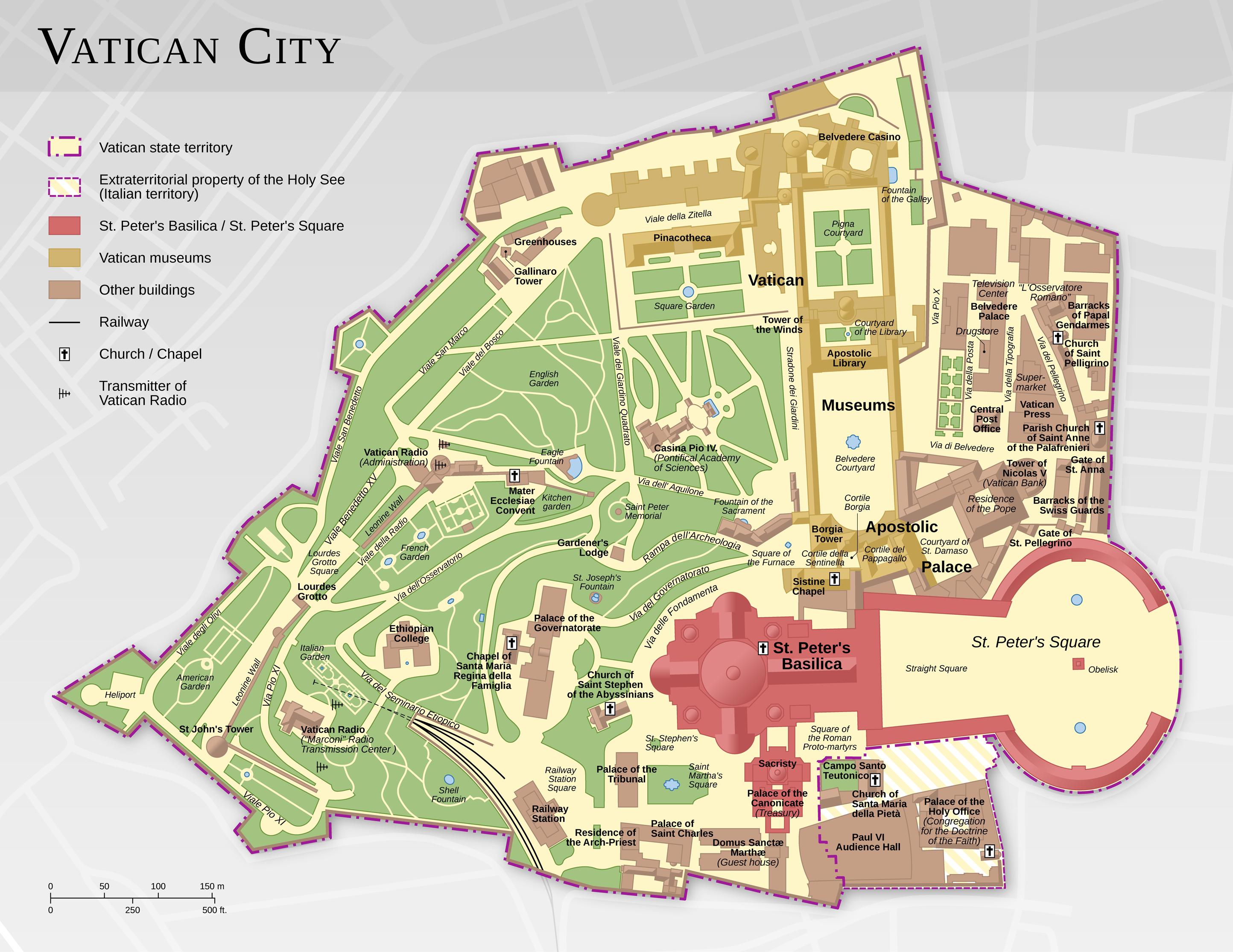
 Map of Vatican CityMap: ThoroeA map of Vatican City (click for full resolution), highlighting notable buildings and the Vatican Gardens. The world's smallest independent state and the episcopal see of the Pope, Vatican City is entirely surrounded by the Italian city of Rome. As such, its geography is primarily urban and its climate similar to Italy's.
 Map: Strebe, using GeocartThe equirectangular projection is a simple map projection attributed to Marinus of Tyre, who Ptolemy claims invented the projection about AD 100. The projection maps meridians to vertical straight lines of constant spacing, and circles of latitude to horizontal straight lines of constant spacing. The projection is neither equal area nor conformal. Because of the distortions introduced by this projection, it has few applications beyond base imagery to be reprojected to some more useful projection.
 Daedongyeojido is a large scale map of Korea produced by Chosun Dynasty cartographer and geologist Kim Jeong-ho in 1861. Considered to mark the zenith of pre-modern Korean cartography, the map consists of 22 separate, foldable booklets, each covering approximately 47 kilometres (29 mi) (north-south) by 31.5 kilometres (19.6 mi) (east-west). Combined, they form a map of Korea that is 6.7 metres (22 ft) wide and 3.8 metres (12 ft) long. Daedongyeojido is praised for precise delineations of mountain ridges, waterways, and transportation routes, as well as its markings for settlements, administrative areas, and cultural sites.
 Map credit: Heinrich C. BerannYellowstone National Park is an American national park located mostly in Wyoming and extending into Montana and Idaho. It was established by the U.S. Congress and signed into law by President Ulysses S. Grant on March 1, 1872. Yellowstone was the first national park in the U.S. and is also widely held to be the first national park in the world. The park is known for its wildlife and its many geothermal features, especially the Old Faithful geyser, one of its most popular landmarks. It has many types of ecosystems, but the subalpine forest is the most abundant. The park is part of the South Central Rockies forests ecoregion. In 1978, Yellowstone was named a World Heritage Site by UNESCO.
 Photo credit: NASAAntarctica, the continent surrounding the Earth's South Pole, is the coldest place on Earth and is almost entirely covered by ice. Antarctica was discovered in late January 1820. Too cold and dry to support virtually any vascular plants, Antartica's flora presently consists of around 250 lichens, 100 mosses, 25-30 liverworts, and around 700 terrestrial and aquatic algal species.
 The geography of Australia, the world's smallest continent, encompasses a wide variety of biogeographic regions. By surface area, it is the sixth-largest country in the world, but as can be seen in this composite satellite image, much of the interior is arid desert. The vast majority of the human population is concentrated along the eastern and southeastern coasts, and it is the fiftieth most populous nation.
 Photograph: Maull & Fox; restoration: Adam CuerdenFanny Bullock Workman (1859–1925) was an American geographer, cartographer, explorer, travel writer, and mountaineer. Together with her husband, William Hunter Workman, she traveled by bicycle through Switzerland, France, Italy, Spain, Algeria and India; after taking up climbing in the Himalayas, she set a women's altitude record on Pinnacle Peak, reaching 23,000 feet (7,000 m). She published eight travel books, with particular focus on the lives of women in the countries she visited, and championed women's rights and women's suffrage.


.svg)
.svg)


.jpeg)


 Categories
 Commons
 Wikibooks
 Wikidata
 Wikinews
 Wikiquote
 Wikisource
 Wikiversity
 Wikivoyage
 Wiktionary